Showing posts with label Stars. Show all posts

Thursday, July 25, 2013

St. Wladyslaw Church, Subotniki

While this town is now part of Belarus (and less than 5 miles from Lithuania), it was once known as Sobotniki, Poland. For centuries, the land and everything on it belonged to the Umiastowski family, one of the oldest aristocratic lines in Eastern Europe. The parish's Catholic church was built in 1904-06 under the direction of the Count Wladyslaw and Countess Janina Umiastowski. It was finished shortly after the Count's death.


A mosaic portrait of the Count as a young man in his military uniform was made by Salviati and it hangs inside the church, to the left of the altar. The bronze gilt frame was from the Łopieńskich workshop in Warsaw and it contains the phrase "Frangas non flectas" ("Thou mayst break, but shall not bend me") and the Count's crown.


A Polish mason named Nowak was first tasked with creating a catacomb mausoleum under the main altar; however, a lot of time and money was wasted on the wrong type of marble and methods.


Finally, Swedish masons were brought in to construct the vaulted crypt under the church, which contains the final resting places of several members of the Umiastowski family. The entrance to the crypt also contains the family motto.


Salviati made the original mosaic decorations for the vaulted ceilings, however, artillery shelling damaged the crypt in 1927 and the Countess ordered a new blue ceiling with golden stars, as well as ten family crests. Salviati delivered the 80 square meters of new mosaics in 1928.


Sources:
Barr, Sheldon. Venetian Glass Mosaics: 1860-1917. London: Antique Collectors' Club, 2008. 138.
Nalecz. Szmat Ziemi I Zycia. Vilnius: The Gebethner Bookshop & Wolff, 1928. 144-146 & 150.
Radzima
Umiastowski
Wikipedia

Tuesday, June 11, 2013

Malbork Castle

Also know as Marienburg, this castle was built by the Teutonic Knights in the late 13th century.  It also served at times as part of the Prussian royal residences.


More than half of the castle was destroyed during World War II.


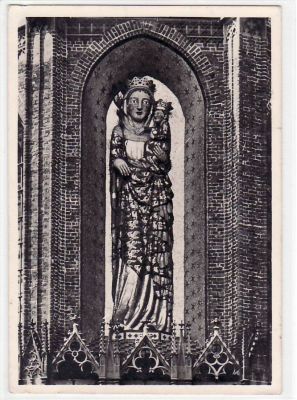
The exterior of the east window of the upper chapel was decorated by the first examples of exterior mosaics by Salviati in what was then still part of Germany. This was restoration work done in 1869-70 to previous mosaics (also Venetian, from the 14th century) adorning the niche of the giant (8 meters) statue of the Virgin Mary. Unfortunately, these mosaics also did not survive the wartime bombings.


A pre-World War II postcard showing the statue and mosaics still intact on the chapel.


The mosaics formed a background of gold with blue stars.


Malbork Chapel with the empty space that previously featured the mosaics and the Virgin


In 2008, an advertisement for a local religious organization showed what the chapel used to look like.

Sources:
The Architect and Contracted Reporter: A Weekly Illustrated Journal of Art, Civil Engineering and Building. "Mosaics in Germany." Vol. 5, April 8, 1871. 182.
Castles and Palaces of the World
Wikipedia
Malbork
pBase gallery
forum Marienburg.pl
Akpool.de
Stadtapartment
Mysteries and Curiosities of Malbork Castle

Friday, June 7, 2013

Basilica of St. Eufemia, Milan

Founded in the 5th century, the church has been rebuilt many times since then, including in 1870 by Enrico Terzaghi. Although the exterior is neo-Romanesque, the interior style is more neo-Gothic.


Salviati mosaics decorate the ceiling and the Grand Portal.


Sources:
Barr, Sheldon. Venetian Glass Mosaics: 1860-1917. London: Antique Collectors' Club, 2008. 134.
Wikipedia IT
Patrizia Rossito on Panoramio
Tripadvisor
Guttae Blogspot
Enrico Sammartini's flickr Photostream