The Italian Renaissance-style memorial to Richard Grosvenor, 2nd Marquess of Westminster stands at the junction of Pimlico Road and Avery Farm Row in London. Grosvenor was a politician and developer who - before his death in 1869 - was an early patron of Chester architect John Douglas.
Erected around 1870, the four faces of the Portland stone and granite
drinking fountain are covered by enamel mosaics by Salviati.
Salviati also made the mosaic reredos for the Douglas designed St. John's Church in Aldford, tying it back to Grosvenor through that additional connection.
Sources:
Introduction to Victorian and Edwardian Architectural Mosaics in London
"Drinking Fountain - geograph.org.uk - 1305384" by PAUL FARMER. Licensed under CC BY-SA 2.0 via Wikimedia Commons
"Fountain on East Side of Junction with Avery Farm Row". National Heritage List for England. English Heritage.
"Richard Grosvenor." Wikipedia.
Showing posts with label Memorial. Show all posts
Saturday, February 7, 2015
Marquess of Westminster Memorial Fountain
Location:
Avery Farm Row, London SW1W, UK
Wednesday, February 26, 2014
Funerary Monuments in Croatian Cemeteries
Ivan Rendic was a Croatian sculptor who studied in Italy - including in Venice - and later worked extensively out of Trieste. He made numerous funerary monuments in the cemeteries around Rijeka (including Kozala, Trsat-Susak, Opatija and Bakar), some of which Salviati also decorated with enamel mosaics. A catalog prepared for the 1893 World Columbian Exposition does not detail exactly which memorials Salviati worked on (and erroneously lists Trieste as the location of the cemeteries), but the following examples were all made by Rendic before 1893 and are embellished with mosaics.
The Bakarcic monument from 1892 in the Kozala cemetery.
Sources:
Barr, Sheldon. Venetian Glass Mosaics: 1860-1917. London: Antique Collectors' Club, 2005. 126.
Metzger-Sober, Branko. "Funerary Monuments by Ivan Rendic in the Croatian Littoral." Ars Adriatica. 3. Dec 2013.
Wikipedia
The interior of the Gorup family mausoleum from 1882 in Rijeka's Kozala cemetery. Josip Gorup had the memorial built after the death of his wife in childbirth, and the carved relief shows the separation of a mother from her eight children.
The Devet/Spilar-Ambrozic memorial from 1885 in the Kozala cemetery.
The Pilepic monument from 1890.
The Stiglich family tombstone from 1891.
The Bakarcic monument from 1892 in the Kozala cemetery.
Sources:
Barr, Sheldon. Venetian Glass Mosaics: 1860-1917. London: Antique Collectors' Club, 2005. 126.
Metzger-Sober, Branko. "Funerary Monuments by Ivan Rendic in the Croatian Littoral." Ars Adriatica. 3. Dec 2013.
Wikipedia
Location:
Kozala, 51000, Rijeka, Croatia
Thursday, October 31, 2013
Buxton Memorial Fountain
S.S. Teulon designed this monument that was erected in 1865 to the memory of Thomas Buxton and others who were involved in the 1834 abolition of slavery in the British Empire. It was originally located in Westminster's Parliament Square, however, it was later moved to its current location in nearby Victoria Gardens.
Salviati decorated the fountain with mosaics, seen mostly around and within the gothic arches and trefoils midway up the structure.
Sources:
Salviati, Antonio. On Mosaics (generally). 1865. 50.
Wikipedia
Patche99z on Wikimedia Commons
Mira66's flickr Photostream
Bob Speel's Website
Salviati decorated the fountain with mosaics, seen mostly around and within the gothic arches and trefoils midway up the structure.
Sources:
Salviati, Antonio. On Mosaics (generally). 1865. 50.
Wikipedia
Patche99z on Wikimedia Commons
Mira66's flickr Photostream
Bob Speel's Website
Location:
Victoria, London SW1V, UK
Wednesday, October 16, 2013
Church on the Heights, Brooklyn
Part of the Dutch Reformed Church, this building was located on the northwest corner of Pierrepont Street and Monroe Place. Salviati made a mosaic portrait of minister and hymn-writer George W. Bethune to be affixed to a Carrara marble memorial tablet to be installed in the church, which Bethune had been associated with.
The church was dedicated in 1851 and it was demolished sometime after 1922. Today, the location is home to the Appellate Division of the Supreme Court of the State of New York and its adjacent parking lot.
Although Salviati's records from 1865 indicate the memorial was for a church in New York, Bethune's biography from 1867 lists the Third Reformed Dutch Church in Philadelphia as containing the mosaic tablet.
This church - located on the northeast corner of Tenth and Filbert Streets - was designed by Thomas Ustick Walter and built 1836-40.
In either case, the portrait now hangs in the New Brunswick Theological Seminary's Gardner A. Sage library.
Sources:
Salviati, Antonio. On Mosaics (generally). 1865. 50-51.
Mast, Gregg. In Remembrance and Hope: The Ministry and Vision of Howard G. Hageman. Grand Rapids: William B. Eerdmans Publishing, 1998. 4.
Van Nest, Rev. A.R. Memoir of Rev. Geo. W. Bethune. New York: Sheldon and Company, 1867. 421.
New York Historical Society Museum & Library
Google Maps
Philadelphia Architects and Buildings
The church was dedicated in 1851 and it was demolished sometime after 1922. Today, the location is home to the Appellate Division of the Supreme Court of the State of New York and its adjacent parking lot.
Although Salviati's records from 1865 indicate the memorial was for a church in New York, Bethune's biography from 1867 lists the Third Reformed Dutch Church in Philadelphia as containing the mosaic tablet.
This church - located on the northeast corner of Tenth and Filbert Streets - was designed by Thomas Ustick Walter and built 1836-40.
In either case, the portrait now hangs in the New Brunswick Theological Seminary's Gardner A. Sage library.
Sources:
Salviati, Antonio. On Mosaics (generally). 1865. 50-51.
Mast, Gregg. In Remembrance and Hope: The Ministry and Vision of Howard G. Hageman. Grand Rapids: William B. Eerdmans Publishing, 1998. 4.
Van Nest, Rev. A.R. Memoir of Rev. Geo. W. Bethune. New York: Sheldon and Company, 1867. 421.
New York Historical Society Museum & Library
Google Maps
Philadelphia Architects and Buildings
Wednesday, August 28, 2013
Albert Memorial
G.G. Scott won the competition to design this memorial to Queen Victoria's late husband in 1863. It is located in London's Kensington Gardens, just to the north of the Royal Albert Hall and not far from the Princess Diana Memorial Fountain.
The cartoons for the eight exterior spandrels, four triangular gables, and the interior of the dome were painted by J.R. Clayton, which Salviati decorated with 1,200 sq ft of Venetian mosaic.
Albert was a great patron of the arts and the gables depict enthroned allegorical figures of Painting, Sculpture, Poetry, and Architecture, while the spandrels shows the artists at work in those fields.
Sources:
Barr, Sheldon. Venetian Glass Mosaics: 1860-1917. London: Antique Collectors' Club, 2008. 18-20.
Wikimedia Commons Photo by DAVID ILIFF. License: CC-BY-SA 3.0
Monceau's flickr Photostream
Photosecrets
Losing It
The cartoons for the eight exterior spandrels, four triangular gables, and the interior of the dome were painted by J.R. Clayton, which Salviati decorated with 1,200 sq ft of Venetian mosaic.
South facade - Poetry
East facade - Painting
North facade - Architecture
West facade - Sculpture
Sources:
Barr, Sheldon. Venetian Glass Mosaics: 1860-1917. London: Antique Collectors' Club, 2008. 18-20.
Wikimedia Commons Photo by DAVID ILIFF. License: CC-BY-SA 3.0
Monceau's flickr Photostream
Photosecrets
Losing It
Tuesday, July 9, 2013
Salisbury Chapel, St. Etheldreda Church
Parts of the Hatfield Parish church date to the 13th century. David Brandon rebuilt the nave in 1872 in a Victorian style.
The north chapel holding the tomb of the 1st Earl of Salisbury Robert Cecil was added in 1618 by his son. The third Marquess had the interior of the chapel adorned with Venetian mosaics by Salviati in 1871.
The Caen marble reredos showing the Marys at the Cross, flanked by St. Etheldreda and St. Alban on either side was carved by Thomas Earp. It was also decorated with Venetian mosaics by Salviati.
Sources:
Pevsner, Nikolaus and Bridget Cherry. Buildings of England: Hertfordshire. New Haven: Yale University Press, 162.
Handbook for Hertfordshire, Bedfordshire, and Huntingdonshire. London: John Murray, 1895. 37.
Images of Europe
Richard Rogerson on Geograph
Chris Beckett's flickr Photostream
Paul Hart on Panoramio
Ian A. Wood's flickr Photostream
The north chapel holding the tomb of the 1st Earl of Salisbury Robert Cecil was added in 1618 by his son. The third Marquess had the interior of the chapel adorned with Venetian mosaics by Salviati in 1871.
The Caen marble reredos showing the Marys at the Cross, flanked by St. Etheldreda and St. Alban on either side was carved by Thomas Earp. It was also decorated with Venetian mosaics by Salviati.
Sources:
Pevsner, Nikolaus and Bridget Cherry. Buildings of England: Hertfordshire. New Haven: Yale University Press, 162.
Handbook for Hertfordshire, Bedfordshire, and Huntingdonshire. London: John Murray, 1895. 37.
Images of Europe
Richard Rogerson on Geograph
Chris Beckett's flickr Photostream
Paul Hart on Panoramio
Ian A. Wood's flickr Photostream
Friday, April 19, 2013
St. Mary's Newtownforbes
The parish church of Clonguish was built in 1861 but underwent a major restoration in 1973.
A Salviati mosaic memorial tablet commissioned by George Forbes, 7th Earl of Granard for his late wife Jane Colclough Grogan-Morgan survived the restoration and can now be found behind the altar.
The Countess of Granard died in 1872 at Johnstown Castle when she was just 32 years old.
Sources:
Barr, Sheldon. Venetian Glass Mosaics: 1860-1917. London: Antique Collectors' Club, 2008. 126.
dr_urbanus (Martin) flickr Photostream
Family Search
seikinsou's flickr Photostream
A Salviati mosaic memorial tablet commissioned by George Forbes, 7th Earl of Granard for his late wife Jane Colclough Grogan-Morgan survived the restoration and can now be found behind the altar.
The Countess of Granard died in 1872 at Johnstown Castle when she was just 32 years old.
Sources:
Barr, Sheldon. Venetian Glass Mosaics: 1860-1917. London: Antique Collectors' Club, 2008. 126.
dr_urbanus (Martin) flickr Photostream
Family Search
seikinsou's flickr Photostream
Monday, March 25, 2013
Prussian War Memorial to the Fallen
Erected in 1880 when the city was called Thorn and was part of Prussia, the Pomnik Poleglych Toruniu was built to commemorate the dead from the wars of years 1860, 1866, 1870 and 1871. It was designed by German architect Johannes Otzen.
Salviati embellished the monument with two pictures of two figures each, six pictures of busts of soldiers, and three inscriptions with a cross and crown.
The memorial was located in what is now Torun's Theater Square, but unfortunately it was demolished in 1920 when the city was liberated from the Prussians and was returned to Polish control.
The structure shares a lot of stylistic elements that are similar to the Chamberlain Memorial of Birmingham from the same year.
Sources:
Barr, Sheldon. Venetian Glass Mosaics: 1860-1917. London: Antique Collectors' Club. 2008. 136.
Europeana
Wikipedia Pl
Wikipedia De
Salviati embellished the monument with two pictures of two figures each, six pictures of busts of soldiers, and three inscriptions with a cross and crown.
The memorial was located in what is now Torun's Theater Square, but unfortunately it was demolished in 1920 when the city was liberated from the Prussians and was returned to Polish control.
The structure shares a lot of stylistic elements that are similar to the Chamberlain Memorial of Birmingham from the same year.
Sources:
Barr, Sheldon. Venetian Glass Mosaics: 1860-1917. London: Antique Collectors' Club. 2008. 136.
Europeana
Wikipedia Pl
Wikipedia De
Location:
Plac Teatralny, ToruĊ, Poland
Tuesday, January 29, 2013
St. Erasmus Chapel in Chester Cathedral
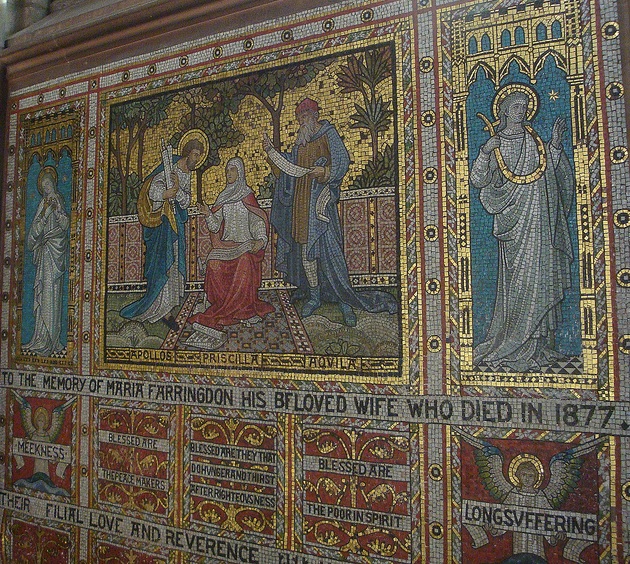
The high altar of Chester Cathedral contains a mosaic of the Last Supper by Salviati from 1876. Around 1870 during the restoration by G.G. Scott, the south aisle of the cathedral was shortened and its east end was converted into the St. Erasmus Chapel.
Designed by Clayton and Bell, the Salviati mosaics in the chapel from 1879 are dedicated to the memory of railroad contractor Thomas Brassey (1805-70) and his wife Maria Farringdon Harrison (d. 1877) by their sons Thomas, Henry Arthur (Harry) and Albert Brassey. Thomas the younger had built the Brassey Institute in Hastings.
Sources:
Wikipedia
Budby's flickr Photostream
Colin Sabin's flickr Photostream
Designed by Clayton and Bell, the Salviati mosaics in the chapel from 1879 are dedicated to the memory of railroad contractor Thomas Brassey (1805-70) and his wife Maria Farringdon Harrison (d. 1877) by their sons Thomas, Henry Arthur (Harry) and Albert Brassey. Thomas the younger had built the Brassey Institute in Hastings.
Sources:
Wikipedia
Budby's flickr Photostream
Colin Sabin's flickr Photostream
Monday, January 7, 2013
Parish Church of All Saints Slingsby
Built in 1867-69, this Victorian church was constructed upon the footprint of the original 12th century building and incorporates various Medieval elements.
Salviati mosaics in a floral motif decorate a marble tablet honoring local doctor Robert Lascelles and his wife Mary, who died in 1884.
Sources:
Parish Church of All Saints Slingsby
A Church Near You
The Street Parishes
jmc4 - Church Explorer's flickr Photostream
Salviati mosaics in a floral motif decorate a marble tablet honoring local doctor Robert Lascelles and his wife Mary, who died in 1884.
Sources:
Parish Church of All Saints Slingsby
A Church Near You
The Street Parishes
jmc4 - Church Explorer's flickr Photostream
Subscribe to:
Posts (Atom)