Showing posts with label Hungary. Show all posts

Friday, August 7, 2015

Fővárosi Serfőzde Rt.

The Fővárosi Serfőzde Rt. (Capitol City Brewery) was established in Budapest's District X in 1913 and began production the following year. It was bought in 1943 by Dreher brewery and later by the Globus Canning Factory (Globus Konzervgyár Rt.). Production stopped in 2009.

Postcard depicting the brewery circa 1920


Salviati, Jesurum, and Co. reportedly made the two mosaics, which decorate separate parts of the enormous, red brick factory complex. The medallions look identical and depict King Mathias Corvinus (Mátyás király) on a golden background shown in a side portrait. The brewery's initials of "F" and "S" flank the face on each side, with the words "VED-JEGY" (trademark or brand) and "MATYAS KIRALY" around it on a ring of blue.


The building framing a large chimney and facing Maglodi Street contains the (currently) more degraded mosaic. The laurel wreath around the mosaic center - appearing to be copper, but likely made of maiolica with an eosin glaze - is attributed to the Zsolnay Porcelain Manufacture of Pécs and measures four meters in diameter.


The second medallion is located on the spandrel of a covered walkway that connects two buildings. This also faces Maglodi Street, but is a much smaller mosaic (detail above).


Sources:
Pilsitz, Martin. On the Industrial Urban Development of Pest in the 19th Century. periodica polytechnica. 43/1 (2012). 37-44.
Balatoni, Mihaly, et al. A Magyar élelmiszeripar története. Budapest: Mezőgazdasági Kiadó, 1986. 533.
Zubrecki, David. Irodanak Hirdetik az Egyik Legszebb Pesti Ipari Muemleket. Index. June 10, 2015. 

Tuesday, August 13, 2013

Prince Primate's Palace, Esztergom

Josef (or Jozsef) Lippert von Granberg designed this neo-Renaissance style building as the residence for Esztergom's archbishops based on a request from Cardinal and Prince Primate Janos Simor. The building is located on the Danube River, right across from Bratislava, Slovaki. It was built on the former site of a Jesuit monastery (the church remains) and construction took place 1881-83. Simor bore all of the costs associated with construction, which - at over 600,000 HUF - were more than double preliminary estimates.


The Prince Primate's Palace with the adjacent St. Ignatius Church

Cardinal Simor was a great patron of the arts. The central stairwell of the building contains not only painted portraits of various Primates, but also a Salviati mosaic of Simor's coat of arms. Its iconography comes from Rev. 12.1: ”A great sign appeared in heaven: a woman clothed with the sun, with the moon under her feet and a crown of twelve
stars on her head.”


The second floor of the building now contains the Christian Museum, which was also founded by Simor. It is open to visitors, while the rest - including the Primates' Archives and the Simor Library - still belong to the church. While a complete picture of the mosaic is unavailable due to the private nature of this part of the building, a piece of it can be seen in the upper left-hand corner of this image.

Sources:
Barr, Sheldon. Venetian Glass Mosaics: 1860-1917. London: Antique Collectors' Club, 2008.135.
Christian Museum
Alan Ford on Wikipedia
Wikipedia - Primasi Palota
Wikipedia - Simor
Szulofalum Bajcs
Kemeny, Jozsef. "Obscure Magyar." Cosmic Construction, 56.
Nagy Gabor on Fotosok Vilaga 
Uj Ember 

Monday, January 14, 2013

St. Stephen's Basilica Budapest

Because construction took over fifty years (between 1851 and 1905), the initial designs for this church were started by Miklos Ybl, but were ultimately completed by Jozsef Hild and Jozsef Kauser. Originally meant to be dedicated to St. Leopold, the patron saint of Austria, that plan was also changed before its opening in lieu of honoring Hungary's first king.


The mosaic tympanum of 1893 located over the main entrance door is Our Lord on the Throne with Angels. It was designed by Mor Than. It is currently covered by a wire mesh to keeps birds away.


Salviati's design of "Christ in Glory" from 1893 served as a blueprint for the final mosaic.


The mosaics in the half dome of the apse featuring angels celebrating five steps in Holy Mass were designed by Karoly Lotz and Gyula Benczur and installed in 1900.


"Pictures in apse of St. Leopold's Cathedral Budapest 36 sq f each."


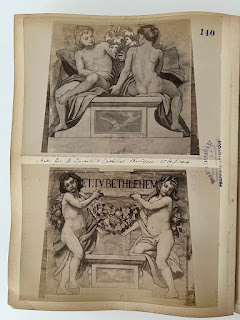
Additional designs from Salviati from the original plans, featuring wingless cherubs.


Sources:
Earth in Pictures
Alma Kaufmann's flickr Photostream
Budapest Christmas
Barr, Sheldon. Venetian Glass Mosaics: 1860-1917. New York: Antique Collectors’ Club Ltd., 2008. 76-79.
Vasarnapi Ujsag. Vol 47, No 46. 1900.
Wikipedia: St. Stephen's Basilica. Accessed February 11, 2022.
Erede Dr. A. Salviati & Co. Venezia Catalog. Items 129-140. "Made for St. Leopold's Cathedral Budapest. 25 sq. ft. each." After 1903. Courtesy of @Troyoz on Twitter