Showing posts with label Tympanum. Show all posts

Monday, October 14, 2013

Bonn Minster

Also known as St. Martin's Cathedral, this is one of Germany's oldest churches, dating back to before the 13th century.


Salviati made a total of 800 square feet of mosaics for the portal and apse of the cathedral in 1894, modeled after cartoons by Professor Martin and Friz Geiges.


Mosaic tympanum of the Annunciation above the entry portal


Detail of the apse mosaic featuring Christ Enthroned, which is based on a depiction in Hagia Sophia and also reminiscent of the one in St. Mark's Basilica. The latter also served as the model for the portrait in St. Augustine's College, Canterbury.

Sources:
Barr, Sheldon. Venetian Glass Mosaics: 1860-1917. London: Antique Collectors' Club, 2008. 127.
Wikipedia
Sacred Destinations: Bonn Munster
Hans Weingartz on Wikimedia Commons
Erke's flickr Photostream
jaime.silva's flickr Photostream
Brian J. McMorrow on pBase

Thursday, June 27, 2013

The Annunciation, Chislehurst

Architect James Brooks built this Catholic church 1868-70.


Nathaniel Westlake designed the mosaic tympanum of The Last Judgment that Salviati made in 1890.


Sources:
Bentjeman, John and Richard Surman. Betjeman’s Best British Churches. London: Harper Collins UK, 2011.
Barr, Sheldon. Venetian Glass Mosaics: 1860-1917. London: Antique Collectors' Club, 2008. 136.
The Annunciation Chislehurst
Philip Chester's flickr Photostream
Siani D's flickr Photostream

Thursday, May 23, 2013

St. Luke's Church Battersea

Architect Frederick William Hunt designed this church, which was built 1882-93.


The choir contains a Salviati mosaic of the winged bull of St. Luke above the north door to the vestry. It was added in 1891 and modeled after the circular window in St. Mary's Battersea.


Sources:
St. Luke's Church
English Heritage. Chapter 3: Churches and Chapels. Draft.
Scott Shaw's A View from Tokyo blog.

Tuesday, April 2, 2013

Sacred Heart Catholic Church, Roscommon

Irish architects Walter Glynn Doolin and Patrick J. Kilgallin designed this church that was begun in 1897 and opened in 1903.


The east-facing facade contains Salviati mosaics including one showing local bishop Laurence Gillooly (holding a map) on the tympanum above the main door. The others depict the Martyrdom of St. Laurence, St. Vincent de Paul and the Sacred Heart.


The sanctuary walls are covered by mosaic angels and the Evangelists. Between the windows, figures of the founding fathers of most of the major European religious orders can be seen.


The floor of the church is also paved in mosaics.


Sources:
Barr, Sheldon. Venetian Glass Mosaics: 1860-1917. London: Antique Collectors' Club, 2008. 138.
The Ecclesiastical Heritage of Galway, Mayo and Roscommon, 32-33.
joekennedy52's flickr Photostream
VMontalbano's flickr Photostream
kterkan's flickr Photostream

Thursday, February 28, 2013

Shrine of the Sacred Heart of Jesus

Located in Bussana Nuova, Italy this church was built 1889-1901 after an earthquake devastated the city.


Piero Saccano supervised the installation of the Salviati mosaics on the facade, including the tympanum above the main door.


The four Evangelists in their symbolic forms surround a seated Christ.


Sources:
Riviera 24
Viaggi Spirituali
Mariella1957's flickr Photostream
Comuni Italiani
Barr, Sheldon. Venetian Glass Mosaics: 1860-1917. London: Antique Collectors' Club, 2008. 131.

Monday, February 4, 2013

Amalfi Cathedral

Also known as the Cathedral of St. Andrew, parts of this structure date to the 12th century.


The mosaic tympanum on the exterior facade is by Salviati from 1891, after Domenico Morelli's painting "The triumph of Christ".


Figures of the twelve Apostles on a gold background by Salviati can also be seen underneath. By 1889, several of these mosaics were already completed but not yet installed.


Salviati also made the mosaic of St. Andrew (Sanctus Andrea) above the main door.


Sources:
Erede Dr. A. Salviati & Co. Venezia Catalog. Item 151. "Enthronement of Christ by Morelli Amalfi. 16 sq f. 2nd Cat." After 1903. Courtesy of @Troyoz on Twitter
Erede Dr. A. Salviati & Co. Venezia Catalog. Item 159. "St. Andrew - Made for the Church of Amalfi. 2nd Cat." After 1903. Courtesy of @Troyoz on Twitter
Wikipedia
Telford, John and Benjamin Aquila Barber. "The London Quarterly Review," 1907, 5:107. 80.
Metcalfe, William Musham and Ruaraidh Erskine. "The Scottish Review." London: Alex Gardner. Vol XIII, January and April 1889. 134.
Mitch Ridder's flickr Photostream

Thursday, January 17, 2013

Neuchatel Museum of Art and History

Located in western Switzerland, this building by architect Leo Chatelain that was constructed between 1880 and 1884 to house what was then called the Museum of Fine Arts and Museum of Painting.


The large mosaic tympanum on the facade depicts The Glorification of Art and was completed around the same time as those in the half dome of the apse of St. Stephen's Basilica in Budapest (1891-1905). While the tympanum is bare on an 1886 etching, a postcard from 1898 shows the completed mosaic, further narrowing down the date.


The facade also contains twelve medallions featuring heads representing different types of human races.

Sources:
Wikipedia
ErikDarcy's TrekEarth Photos
Adventures in Architecture
Barr, Sheldon. Venetian Glass Mosaics: 1860-1917. New York: Antique Collectors’ Club Ltd., 2008. 133 & 139.
e-Pics
Amecoleour

Wednesday, January 16, 2013

Birmingham Council House

Designed by local architect Yeoville Thomason in an Edwardian Renaissance style, this building from 1874-79 houses the city council.


The facade contains a central balcony with a niche under the portico that contains a mosaic tympanum by Salviati featuring Municipality giving "Stability" to Liberty and "Power" to Law, while Science, Art, Commerce and Industry look on. The name of the mosaic is not "Brittania Rewarding the Manufactures", as that is the title of the sculpture that represents a similar scene, found on top of the building.


Sources:
British Listed Buildings
Wikimedia Commons Photo by GavinWarrin
The website of Bob Speel
British Association for the Advancement of Science. "Handbook of Birmingham." Birmingham: Hall and English Printers, 1886. 123.
Foster, Andy and George Demidowicz. Pevsner Architectural Guides: Birmingham. New Haven: Yale University Press, 2005. 63.

Monday, January 14, 2013

St. Stephen's Basilica Budapest

Because construction took over fifty years (between 1851 and 1905), the initial designs for this church were started by Miklos Ybl, but were ultimately completed by Jozsef Hild and Jozsef Kauser. Originally meant to be dedicated to St. Leopold, the patron saint of Austria, that plan was also changed before its opening in lieu of honoring Hungary's first king.


The mosaic tympanum of 1893 located over the main entrance door is Our Lord on the Throne with Angels. It was designed by Mor Than. It is currently covered by a wire mesh to keeps birds away.


Salviati's design of "Christ in Glory" from 1893 served as a blueprint for the final mosaic.


The mosaics in the half dome of the apse featuring angels celebrating five steps in Holy Mass were designed by Karoly Lotz and Gyula Benczur and installed in 1900.


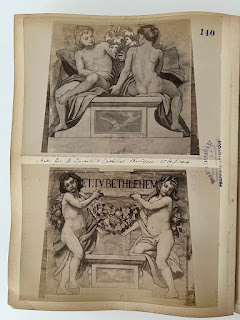
"Pictures in apse of St. Leopold's Cathedral Budapest 36 sq f each."


Additional designs from Salviati from the original plans, featuring wingless cherubs.


Sources:
Earth in Pictures
Alma Kaufmann's flickr Photostream
Budapest Christmas
Barr, Sheldon. Venetian Glass Mosaics: 1860-1917. New York: Antique Collectors’ Club Ltd., 2008. 76-79.
Vasarnapi Ujsag. Vol 47, No 46. 1900.
Wikipedia: St. Stephen's Basilica. Accessed February 11, 2022.
Erede Dr. A. Salviati & Co. Venezia Catalog. Items 129-140. "Made for St. Leopold's Cathedral Budapest. 25 sq. ft. each." After 1903. Courtesy of @Troyoz on Twitter