Showing posts with label Lessing. Show all posts

Thursday, August 29, 2013

Ethnological Museum, Berlin

Located next to the Museum of Decorative Arts (also known as the Gropius Bau) at Koniggratzer Strasse 120 (now Stresemann Strasse), this museum was built in 1880-86 by architect Hermann Ende.


Otto Lessing designed cartoons of the (then) seven planets and the solar system, seasons, arts and industry, as well as phases of life which Salviati applied in mosaic to the ceiling of the circular entrance hall.


As with many of Berlin's buildings, this museum was also damaged in World War II. It served as the Museum of Pre- and Early History until 1961, when it was eventually razed.


In 1954


In 1961

The southeastern corner of Stresemann Strasse and Niederkirchner Strasse now contains a parking lot.


Sources:
Barr, Sheldon. Venetian Glass Mosaics: 1860-1917. London: Antique Collectors' Club, 2008. 136.
Grieben-Verlag. Berlin, Potsdam und Umgebungen: Praktischer Wegweiser. 118.
Westermann, George et. al. Westermanns Monatschefte. 62. G. Westermann, 1887. 375.
Academic
Staadliche Museen zu Berlin
Wolfsraum's flickriver
Architekten-Verein zu Berlin. Berlin und Seine Bauten: Der Hochbau. Berlin: W. Ernst, 1896. 228-229.
Potsdamer Platz 
Google Maps
eBay

Friday, August 23, 2013

New York Insurance Company, Berlin

Not to be confused with the New York Equitable Insurance Company at 43 Leipziger Strasse, this building was designed in 1880 by Kayser and von Grossheim and was located farther west, on the corner of Leipziger and Wilhelm Strasse.


Two facades of the palace contained Salviati mosaics of allegorical depictions of cities modeled after cartoons by Otto Lessing. They included: London, Paris, Berlin, Vienna, New York, and Rome.


Facade detail of the mosaics featuring two cities between windows on the third and fourth levels

Although the building next to it at 125 Leipziger Strasse survived, the New York Insurance Company building was destroyed in World War II. In typical Berlin fashion, it's been replaced by a modern office building.


Sources:
Barr, Sheldon. Venetian Glass Mosaics: 1860-1917. London: Antique Collectors' Club, 2008. 136.
Grieben-Verlag. Berlin, Potsdam und Umgebungen: Praktischer Wegweiser. 140.
Guide through Germany, Austria-Hungary, Italy, Switzerland, France, Belgium, Holland and England. Berlin: J. Reichmann and Cantor, 1896. 12.
Baedeker, Karl. Northern Germany: as far as the Bavarian and Austrian frontiers. 10th ed. London: Dulau and Co., 1890. 55.
Europeana
Senatsvervaltung
Kleinanzeigen eBay
Zeno

Wednesday, August 14, 2013

Halle Opera House

When this theater was built in 1886, it was known locally as the Stadt-Theater Halle. It was designed by Heinrich Christian Seeling.


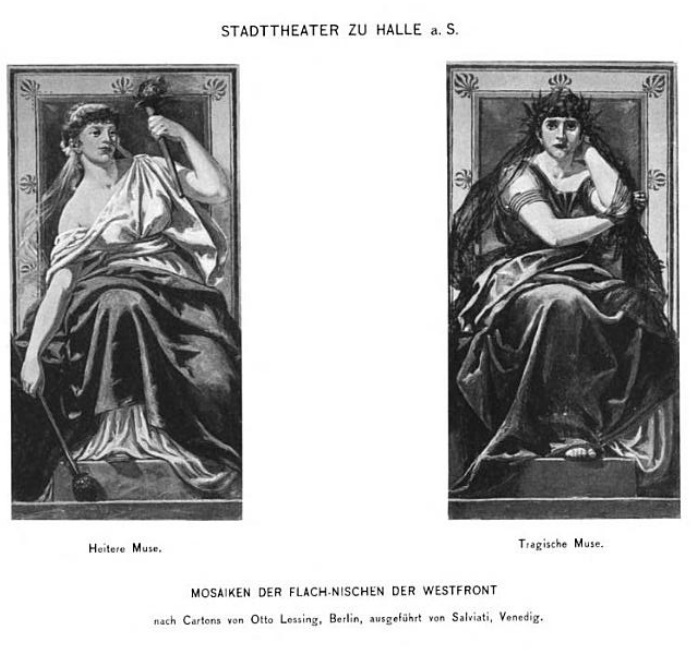
Salviati's mosaic figures and ornaments, designed by Otto Lessing of Berlin, decorated the original building's western facade including the spandrels above the arched windows, as well as the niches above the staircase.


The muses of Serenity and Tragedy were depicted in the mosaics located in the flat niches.


A bomb attack on March 31, 1945 destroyed much of the theater and it was subsequently rebuilt between 1949 and 1954.


Sources:
Barr, Sheldon. Venetian Glass Mosaics: 1860-1917. London: Antique Collectors' Club, 2008. 130, 136.
Staude, Gustav. Das Stadt-theater zu Halle. 1886. 15, 59. 
Wikipedia
Wikimedia Commons
Musical-total
Theatre Database

Tuesday, July 23, 2013

Kayserzinn Headquarters, Cologne

Located on the corner of 85-87 Hohe Strasse and Bruckenstrasse, this magnificent building contained the Cologne headquarters of metalworkers J.P. Kayser & Sohn. Built 1884-86, it was actually designed by Heinrich Joseph Kayser (of Kayser and Grossheim), the younger brother of tinsmith Engelbert Kayser.


Salviati decorated the facade with mosaics of four periods, infants, and ornaments after cartoons by Otto Lessing.


Much of Cologne was destroyed in World War II, including the Kayser building which was hit in 1943, but the area has since been rebuilt. Containing many shops and leading to Cologne Cathedral, it is now a popular pedestrian area.


Sources:
Baldry, Alfred Lys. Modern Mural Decoration. London: George Newnes, Ltd., 1902. 52.
Barr, Sheldon. Venetian Glass Mosaics: 1860-1917. London: Antique Collector's Club, 2008. 136.
Bilderbuch Koeln
Wikipedia DE
Wikimedia Commons
Wikipedia