Showing posts with label Commercial. Show all posts

Wednesday, November 20, 2013

St. Saviour Church, Aberdeen Park

William White designed this church in 1865-66 with a distinct polychrome brickwork.


The stone triptych reredos contained a central crucifixion mosaic sometimes misattributed to Sir Henry Layard. Since Layard was a politician and explorer, this error was more than likely due to the fact that he was partners with Salviati in their joint mosaic business, which made the mosaic.

The church was closed in 1980 and the parish was united with Christ Church, Highbury Grove. In 1990, the dilapidated space was turned into the Florence Trust's artists studios.

View of the western end

View of the eastern end. The top of the stone reredos is visible above the white screen, which was installed to conserve the artifacts.


Sources:
Cherry, Bridget. London: North. New Haven: Yale University Press, 1998. 659.
Hadley, Dennis. "Powell's Opus Sectile Locations." pdf. 32.
Davies, John Andrew. "Site Unseen: St. Saviour's, Aberdeen Park, London." The Independent. Dec 19, 1995.
AIM25 'Islington: Churches', A History of the County of Middlesex: Volume 8: Islington and Stoke Newington parishes (1985), pp. 88-99.
The detailed photographs of the reredos was kindly provided by Neil Jefferies, Studio Manager at The Florence Trust.

Friday, August 23, 2013

New York Insurance Company, Berlin

Not to be confused with the New York Equitable Insurance Company at 43 Leipziger Strasse, this building was designed in 1880 by Kayser and von Grossheim and was located farther west, on the corner of Leipziger and Wilhelm Strasse.


Two facades of the palace contained Salviati mosaics of allegorical depictions of cities modeled after cartoons by Otto Lessing. They included: London, Paris, Berlin, Vienna, New York, and Rome.


Facade detail of the mosaics featuring two cities between windows on the third and fourth levels

Although the building next to it at 125 Leipziger Strasse survived, the New York Insurance Company building was destroyed in World War II. In typical Berlin fashion, it's been replaced by a modern office building.


Sources:
Barr, Sheldon. Venetian Glass Mosaics: 1860-1917. London: Antique Collectors' Club, 2008. 136.
Grieben-Verlag. Berlin, Potsdam und Umgebungen: Praktischer Wegweiser. 140.
Guide through Germany, Austria-Hungary, Italy, Switzerland, France, Belgium, Holland and England. Berlin: J. Reichmann and Cantor, 1896. 12.
Baedeker, Karl. Northern Germany: as far as the Bavarian and Austrian frontiers. 10th ed. London: Dulau and Co., 1890. 55.
Europeana
Senatsvervaltung
Kleinanzeigen eBay
Zeno

Tuesday, August 6, 2013

Palazzo Salviati

The Salviati companies have occupied several locations within the Veneto, including in Murano and in Venice.
The firm was established in 1859 in Murano's relatively plain, 12th century Palazzo da Mula.


Another early showroom in Venice was in the Palazzo Barbarigo, which is a 16th century building that the company covered in mosaic murals in 1868.


In 1896, Salviati had 23 rooms full of their wares in Palazzo Bernardo, which was not adorned with mosaics.


The Palazzo Salviati is located across from the Santa Maria del Giglio vaporetto station and while the mosaics were added in 1924 and are much younger than many of the others documented on this site, the building has been added because it is a very prominent architectural landmark in Venice. As one of the most visible examples of the Salviati name connected to mosaics, it would have been remiss to leave it out.


Sources:
Robertson, Alexander. Through the Dolomites. 1896. 236.
Simonis, Damien. Venice and the Veneto. Lonely Planet, 2008. 131.
Plant, Margaret. Venice: Fragile City, 1797-1997. New Haven: Yale University Press, 2002. 177.
RIBA
pBase Gallery
unofeld781 on Wikimedia Commons
abxbay on Wikimedia Commons

Friday, August 2, 2013

Central Hotel, Berlin

Located on Friedrichstrasse between Georgenstrasse to the north and Dorotheenstrasse to the south, and facing the Central Railway Station, this grand hotel was built in 1878-80. It was designed by architects Hermann Von der Hude and Julius Hennicke.  It boasted having a telephone, electricity, three elevators, and baths on every floor.


Georgenstrasse corner with one of the building's four 98 foot high coupolas

A mosaic frieze designed by Herman Geber ran above the eighty-eight second floor windows/window-doors on the external facade. It was composed of flower garlands adorning the names of the world's most important cities on a gold background. The central panel on the Georgenstrasse corner clearly shows "Constantinopel" (sic).


The Dorotheenstrasse corner


In 1881, Salviati had a showroom in the Central Hotel, while the Venice and Murano Company had theirs nearby at 16 Lindenstrasse. Containing 600 rooms, in 1885 the Central Hotel was still the largest hotel in Germany.


The covered courtyard, or Winter Garden, held 2,500 people and it hosted one of Berlin's best-known variety theaters starting in 1887. The entire hotel was destroyed in World War II.


Dorotheenstrasse corner, March 21, 1945


The same corner today

Sources:
Barr, Sheldon. Venetian Glass Mosaics: 1860-1917. London: Antique Collectors' Club, 2008. 135.
The Builder. April 24, 1880. 504.
Baedekker's Guide Books: Northern Germany. 1881.
Wikimedia Commons Scan from book: Landesdenkmalamt Berlin (Ed.), Denkmale in Berlin, Bezirk Mitte, Ortsteil Mitte, Petersberg 2003, p. 112.
Wikimedia Commons W. Pembroke Fetridge Harper's hand-book for travellers in Europe and the east, 1, Harper & Brothers
Dr. Habbo Knoch, Habilitationsprojekt, postcard from 1898
Wikimedia Commons postcard from 1900
Wikimedia Commons destruction, March 21 1945

Tuesday, July 30, 2013

Unirea Lyceum, Focsani

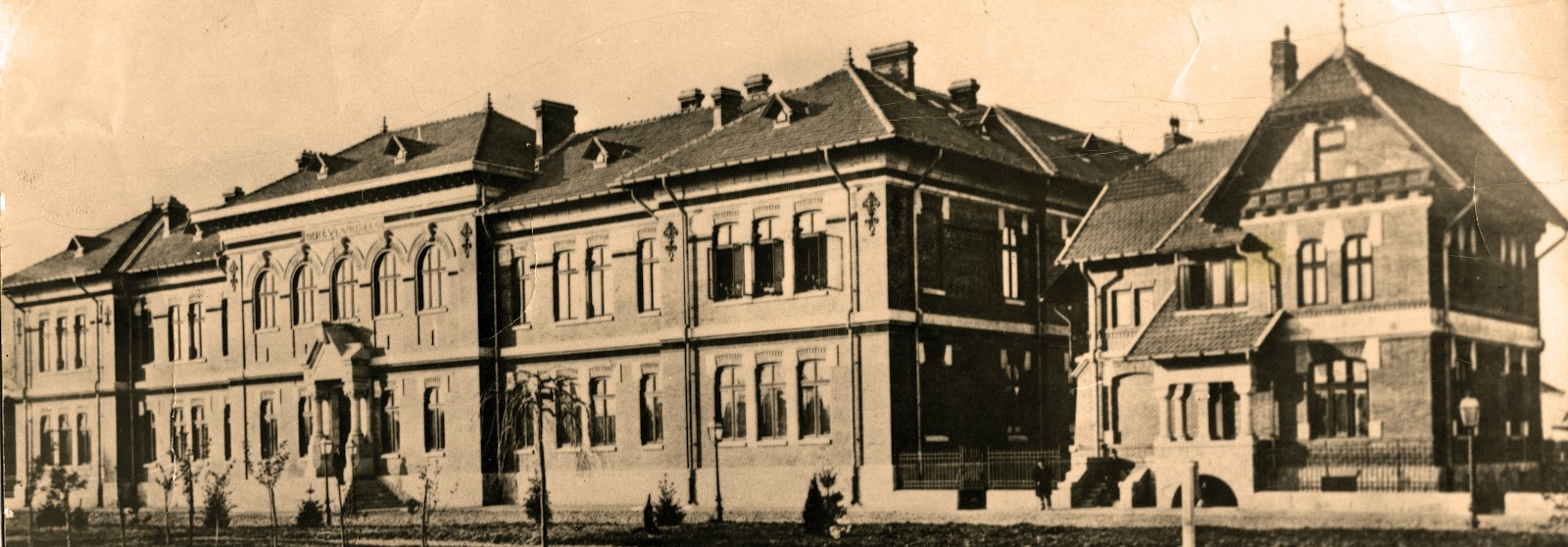
Established in 1866, the Colegiul National Unirea  was initially called the Alexandru Iona Carzu National College. The name was changed in 1880, when architect Constantin Baicoianu began construction on the new school, which was finished in 1900.


A Salviati mosaic decorates the entrance gable, much like on the Roman Voda Lyceum from 1899. 
 

Sources:
Barr, Sheldon. Ventian Glass Mosaics: 1860-1917. London: Antique Collectors' Club, 2008. 138.
Colegiul National Unirea
Bacalaureat 2012

Tuesday, July 23, 2013

Kayserzinn Headquarters, Cologne

Located on the corner of 85-87 Hohe Strasse and Bruckenstrasse, this magnificent building contained the Cologne headquarters of metalworkers J.P. Kayser & Sohn. Built 1884-86, it was actually designed by Heinrich Joseph Kayser (of Kayser and Grossheim), the younger brother of tinsmith Engelbert Kayser.


Salviati decorated the facade with mosaics of four periods, infants, and ornaments after cartoons by Otto Lessing.


Much of Cologne was destroyed in World War II, including the Kayser building which was hit in 1943, but the area has since been rebuilt. Containing many shops and leading to Cologne Cathedral, it is now a popular pedestrian area.


Sources:
Baldry, Alfred Lys. Modern Mural Decoration. London: George Newnes, Ltd., 1902. 52.
Barr, Sheldon. Venetian Glass Mosaics: 1860-1917. London: Antique Collector's Club, 2008. 136.
Bilderbuch Koeln
Wikipedia DE
Wikimedia Commons
Wikipedia

Monday, July 8, 2013

Roman Voda Lyceum

The Roman Voda National College is a primary and high school in the city of Roman. It was established in 1872 and it moved into its current location in 1899.


Salviati decorated the facade, along with those of two other high schools in the Romanian cities of Pitesti and Focsani with mosaic spandrels featuring a floral motif and heraldry in the gable above the entrance.


Sources:
Barr, Sheldon. Ventian Glass Mosaics: 1860-1917. London: Antique Collectors' Club, 2008. 138.
Wikipedia RO
Zang
Yahoo Groups
CDT Photo

Wednesday, June 26, 2013

Cercle de Aix-Les-Bains

Parisian architect Abel Boudier designed the Grand Casino for Victor Emmanuel II and it opened in 1850. It was substantially expanded over the years and it was even used as a hospital during World War I.


Salviati decorated the vaulted ceiling of the dome of the South Hall with 300 sq meters of mosaics in 1882-83 after cartoons by Charles Lameire.


Amongst the designs are the twelve symbols of the zodiac, the four seasons, two angels, flora and other stylized motifs.


In 1936, architect Charles Siclis whitewashed much of the interior decoration; however, after a fire in 1963 and further remodeling in the 1980's, the casino has been restored to its former glory.

Sources:
Barr, Sheldon. Venetian Glass Mosaics: 1860-1917. London: Antique Collectors' Club, 2008. 129.
Lemoine, Bertrand and Alexandra Bonfante Warren. Architecture in France 1800-1900. New York: Harry N. Abrams, 1998. 99.
Wikipedia
Jazz Age Club
Timberdine
Bibliotheque Municipale de Lyon
Maxted Travels
Hotel Metropole
Patrimoine Aix-les-bains
Aix les Bains
Visitesclemence's flickr Photostream

Friday, May 24, 2013

St. Stephen's Church, Hampstead

S.S. Teulon's 1871 church became redundant in 1977 and the interior was severely vandalized over the next twenty years.
 

In 1998, the church was joined with the school next door and since then, the building has been restored and is now used to hold events such as weddings or birthday celebrations.


Salviati mosaic roundels of various Passion symbols can still be found in the former chancel, while most in the nave seem to have been lost. 


A few roundels featuring angels that surround a rose window above the entrance to the side chapel are intact.


Sources:
Cherry, Bridget. The Buildings of England: London 4: North. New Haven: Yale University Press, 1998. 206.
Barr, Sheldon. Venetian Glass Mosaics: 1860-1917. London: Antique Collectors' Club, 2008. 125.
Telegraph UK
Genshin's Intuition's flickr Photostream
Pashmin@'s flickr Photostream
IanVisits' flickr Photostream

Wednesday, March 27, 2013

Palazzo Barbarigo Venice

Located near the entrance to the magnificent Grand Canal on the left side about halfway between the entrance to the canal at the Doge's Palace and the Ponte dell' Accademia, this 16th century building was used for the design, light manufacture (cutting and assembly of the smalti), sale and display of Salviati mosaics.


This is not the same building as the Palazzo Barbarigo Hotel, which is further down the canal, but rather the one just a few hundred feet from the location of the Peggy Guggenheim Collection. Coincidentally, another two hundred feet past the Guggenheim building is the Palazzo Salviati, a 1924 building that was also lavishly decorated with mosaics to advertise the company's products.


The mosaic scenes on the Barbarigo's maritime facade were added in 1868. The central frieze shows thirty-five cherubs pursuing various artistic endeavors including painting, drawing, sculpture and architecture.


The two individual murals - designed by Giulio Carlini - commemorate 16th century royal visits to Venice including Charlemagne (Charles V, Holy Roman Emperor) speaking to Titian on the scaffolding of St. Mark's Basilica. A young mosaicist looks on from above, pausing from his work.


The second mural shows the future French King Henry III in 1574 on the Doge's barge along with a team of glassmakers.


Portraits of arguably the two most famous Venetian painters - Titian and Tintoretto - are located above each scene. St. Mark's lion - the symbol of the city of Venice - tops one of the two individual portraits, while the back rooster - the symbol of Murano - crowns the other.


Sources:
Barr, Sheldon. Venetian Glass Mosaics: 1860-1917. London: Antique Collectors' Club, 2008. 27, 31-32.
Venice Daily Photo
Branislav Slantchev on Gotterdamerung
HEN-Magonza's flickr Photostream
Smith, George Ed. The Cornhill Magazine. XIX. London: Smith, Elder and Co., January to June, 1869. 462.

Wednesday, March 13, 2013

Old Bank, Stratford-upon-Avon

Built for the Birmingham Banking Company in 1883, the Old Bank building was designed by Harris and Harris Architects.


The mosaic portrait of William Shakespeare by Salviati can be found above the main entry door.


The mosaic's design is based on Shakespeare's Monument in the city's Holy Trinity Church.


The original memorial bust that Shakespeare's wife commissioned after his death is located in the church where the author was both baptized and buried.


Sources:
Alan Murray-Rust at Geograph
The urban snapper's flickr Photostream
Barr, Sheldon. Venetian Glass Mosaics: 1860-1917. London: Antique Collectors' Club, 2008. 136.
Sculpture Portrait of William Shakespeare
The Historic Spine