Showing posts with label Poland. Show all posts

Wednesday, July 31, 2013

Scheibler Palace, Lodz

This neo-Renaissance building was rebuilt in 1886-88 for Lodz's "Cotton King" Karl Wilhelm Scheibler .


The front elevation today.


The rear elevation before 1901.
Salviati decorated the fireplace mantle in Scheibler's office with a mosaic of a gypsy woman (or alternately called a Turkish woman).  A stand-alone, identical mosaic dated 1884 was sold in 2011 by a private collector in Connecticut for $32,500 through Christie's auction house.


The figure in the mosaic bears an uncanny resemblance to the woman in Pre-Raphaelite John William Waterhouse's 1873 painting "The Unwelcome Companion", including the tilt of her head and the shawl across her abdomen.


The building now houses the Lodz Film Museum, but a large part of the residence has also been preserved.


Sources:
Bedford, Neal. Lonely Planet: Poland. 2008. 126.
Wikipedia - Scheibler
Olcsasosna on Wikimedia Commons
Polimerek on Wikimedia Commons
Kinomuzeum
Christie's 
Wikipedia - Waterhouse

Tuesday, June 11, 2013

Malbork Castle

Also know as Marienburg, this castle was built by the Teutonic Knights in the late 13th century.  It also served at times as part of the Prussian royal residences.


More than half of the castle was destroyed during World War II.


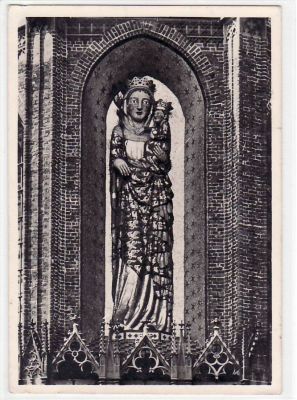
The exterior of the east window of the upper chapel was decorated by the first examples of exterior mosaics by Salviati in what was then still part of Germany. This was restoration work done in 1869-70 to previous mosaics (also Venetian, from the 14th century) adorning the niche of the giant (8 meters) statue of the Virgin Mary. Unfortunately, these mosaics also did not survive the wartime bombings.


A pre-World War II postcard showing the statue and mosaics still intact on the chapel.


The mosaics formed a background of gold with blue stars.


Malbork Chapel with the empty space that previously featured the mosaics and the Virgin


In 2008, an advertisement for a local religious organization showed what the chapel used to look like.

Sources:
The Architect and Contracted Reporter: A Weekly Illustrated Journal of Art, Civil Engineering and Building. "Mosaics in Germany." Vol. 5, April 8, 1871. 182.
Castles and Palaces of the World
Wikipedia
Malbork
pBase gallery
forum Marienburg.pl
Akpool.de
Stadtapartment
Mysteries and Curiosities of Malbork Castle

Friday, May 3, 2013

Kindermann Palace, 137/139 Piotrkowska Street

The Italianate Renaissance style villa belonging to Polish textile magnate Julius Kindermann in Lodz was designed by Viennese architect Karl Seidl and local architect Gustav Landau-Gutenteger. It was built 1903 and currently houses an Art Gallery.


The allegorical mosaic frieze on the facade representing trade and industry is by Salviati from 1907 after a design by Alois Hans Schram.


Agriculture


Commerce and Shipping

Sources:
Solsticeoverslept's Picasa webalbum
Wikitravel
Wikipedia PL
Lodz Tourist Trail Villas and Palaces
eTwinning
Cambridge 2000

Monday, April 8, 2013

Poznanski Mausoleum, Lodz

Izrael Poznanski, a local textile magnate, donated 10.5 hectares of his own land to the city of Lodz in order to build a new Jewish cemetery in 1891 after the original "Old Cemetery" of 1811 proved to be too small. Since then, it has become the biggest Jewish cemetery in Europe.


Poznanski died in 1900 and along with his wife Eleanora, is entombed in this grand, open-air mausoleum resembling a Greek temple that was designed by architect Adolf Seligsohn of the Berlin firm Cremer and Wolffenstein. It was built 1903-05.


The oriental-style mosaics found in the dome were restored in 1993.

Sources:
Wikipedia
Wikipedia DA
A Virtual Tour of Jewish Lodz 
Magic Madzik's flickr Photostream
ZzZachary's flicrk Photostream
Jewish Community of Lodz
Centrum Dialogu
Bedoire, Frederic. The Jewish Contribution to Modern Architecture: 1830-1930. Jersey City: KTAV Publishing, Inc., 2004. 404, 412.

Monday, March 25, 2013

Prussian War Memorial to the Fallen

Erected in 1880 when the city was called Thorn and was part of Prussia, the Pomnik Poleglych Toruniu was built to commemorate the dead from the wars of years 1860, 1866, 1870 and 1871. It was designed by German architect Johannes Otzen.


Salviati embellished the monument with two pictures of two figures each, six pictures of busts of soldiers, and three inscriptions with a cross and crown.


The memorial was located in what is now Torun's Theater Square, but unfortunately it was demolished in 1920 when the city was liberated from the Prussians and was returned to Polish control.

The structure shares a lot of stylistic elements that are similar to the Chamberlain Memorial of Birmingham from the same year.

Sources:
Barr, Sheldon.  Venetian Glass Mosaics: 1860-1917. London: Antique Collectors' Club. 2008. 136.
Europeana
Wikipedia Pl
Wikipedia De