Showing posts with label Crucifixion. Show all posts

Tuesday, January 27, 2015

St. John the Baptist, Aldford

Designed by architect John Douglas, this church was built in 1865-66 at the expense of Richard Grosvenor, the 2nd Marquess of Westminster.


The church's reredos contains five mosaic panels by Salviati. Morris and Co. made the stained glass in the East window after a design by Edward Burne-Jones.


Sources:
English Heritage, "Church of St John the Baptist, Aldford (1135984)", National Heritage List for England
St. John the Baptist, Aldford. Wikipedia. 
A Church Near You. 
British Listed Buildings.

Tuesday, January 21, 2014

St. Mary Magdalene Church, Altofts

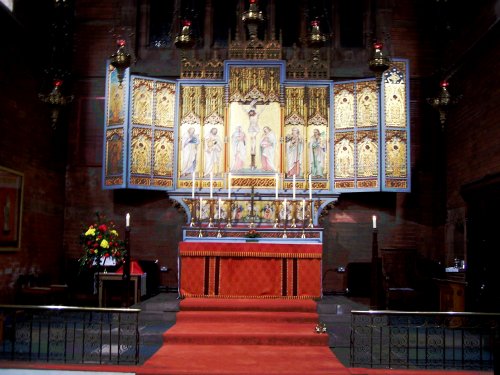
This church was built by architects Richard Life Adams and John Kelly of Leeds between 1873-90. It was consecrated in 1878, by which time the reredos was also completed.


The Caen stone reredos was carved by Leeds sculptor Canova Throp. The mosaic embellishment was made by Salviati after Pietro Perugino's 15th century fresco in Florence's cloister of Santa Maria Maddalena dei Pazzi.


Perugino's "Crucifixion" depicts two additional figures: St. Bernard on the left in white and St. Benedict on the right in blue.


Salviati's interpretation for the mosaic reredos.


The Virgin Mary is on the left panel.


Mary Magdalene is seen praying at Christ's feet.

St. John the Baptist is on the right.

Sources:
Treasures Revealed in Wakefield 2010. 18.
Pevsner, Nikolaus. Yorkshire: The West Riding. New Haven: Yale University Press, 2001. 80.
"New Church of St. Mary Magdalene." The British Architect: A Journal of Architecture. Vol. 10. Nov 1878. 185.
JThomas on Geograph
Museums in Florence
Photographs of the reredos were kindly provided by the Church Warden of St. Mary Magdalene's, Altofts

Wednesday, November 20, 2013

St. Saviour Church, Aberdeen Park

William White designed this church in 1865-66 with a distinct polychrome brickwork.


The stone triptych reredos contained a central crucifixion mosaic sometimes misattributed to Sir Henry Layard. Since Layard was a politician and explorer, this error was more than likely due to the fact that he was partners with Salviati in their joint mosaic business, which made the mosaic.

The church was closed in 1980 and the parish was united with Christ Church, Highbury Grove. In 1990, the dilapidated space was turned into the Florence Trust's artists studios.

View of the western end

View of the eastern end. The top of the stone reredos is visible above the white screen, which was installed to conserve the artifacts.


Sources:
Cherry, Bridget. London: North. New Haven: Yale University Press, 1998. 659.
Hadley, Dennis. "Powell's Opus Sectile Locations." pdf. 32.
Davies, John Andrew. "Site Unseen: St. Saviour's, Aberdeen Park, London." The Independent. Dec 19, 1995.
AIM25 'Islington: Churches', A History of the County of Middlesex: Volume 8: Islington and Stoke Newington parishes (1985), pp. 88-99.
The detailed photographs of the reredos was kindly provided by Neil Jefferies, Studio Manager at The Florence Trust.

Thursday, September 19, 2013

Grace Church, New York

The church was founded in 1818, but James Renwick, Jr. designed the current, early Gothic Revival building that was began in 1843 and consecrated in 1846.


The carved marble reredos contains a central Venetian mosaic panel of the Savior's Ascension with Christ surrounded by his eight disciples, while two apostles in individual arcades flank either side.


Renwick also designed the reredos, which was carved by English sculptors Ellin and Kitson in 1878. Clayton and Bell, as well as Henry Holiday also made stained glass for the church.


The chancel floor is marble mosaic also by Salviati, Burke and Company showing three angels with emblems of the Crucifixion.


Sources:
The Churchman. Vol. 40. Nov. 22, 1879. 580.
Wikipedia
Grace Church 
MuseumPlanet on Panoramio
Panoramio
Mattron's flickr Photostream

Thursday, June 20, 2013

Royal Military Chapel, Wellington Barracks

The chapel was built in 1838 and it has served the seven Regiments of the Household Division. It is the only remaining military chapel in London.


G.E. Street remodeled the chapel in 1877-78.


1882 interior drawing


1899 photograph


The chapel was heavily damaged by bombing during World War II, first during the blitz in 1940 and 1941, and then more seriously in 1944 when 121 soldiers and civilians were killed.


It was rebuilt in the early 1960s and the chancel mosaic can still be seen in the original chancel, which had remained intact.


The chancel is decorated with three scenes: the Bearing of the Cross, the Crucifixion and the Descent from the Cross. John Clayton designed the cartoons for the mosaics, which were executed by Salviati and Burke.


Sources:
London Wellington Barracks. Royal Military Chapel, Wellington Barracks. London: Hatchards, Piccadilly, 1882. 76.
"The Royal Military Chapel Wellington Barracks." The Architect. May 29, 1879. 331.
John Salmon on Wikimedia Commons
Wikipedia
British Army
British Listed Buildings
Colin Hepburn's flickr Photostream
English Heritage
War 44 Forums
Paul Farmer on Geograph
The Guards Chapel Tragedy
eBay
Prints-4-All

Thursday, May 30, 2013

Parish Church of St. Faith's

Designed by the firm of G.E. Grayson and Edward Ould and financed by Douglas Horsfall, this red brick church was built 1898-1900.


The mosaic triptych by Salviati was installed in 1901.


Sources:
Parish Church of St. Faith
Wikipedia
Pevsner, Nikolaus and Richard Pollard. The Buildings of England: Lancashire. New Haven: Yale University Press, 2006. 95.

Monday, May 20, 2013

St. Paul's Cathedral, Melbourne

Built on the site of a former parish church, this Anglican cathedral was designed by William Butterfield and built 1880-91.


Butterfield's design


The cartoon for the 300 square foot reredos was made by Clayton and Bell. It depicts the Crucifixion and Last Supper on top, with a cross in the middle that is flanked by Saints Peter and Paul.


Sources:
Barr, Sheldon. Venetian Glass Mosaics: 1860-1916. London: Antique Collectors' Club, 2008. 126.

Friday, April 26, 2013

St. James Church Cowley

This 12th century Norman church was enlarged by G.E. Street in 1864-65.


Salviati's ornamental decoration for the church can be seen in the mosaic background of the Crucifixion on the altar reredos.


Sources:
Moore, Helen. St. James's Church, Beauchamp Lane, Cowley, Oxfordshire. Thames Valley Archeological Services Ltd., 2003. 6.
Cowley Team Ministry
Oxfordshire Churches
Rex Harris' flickr Photostream

Monday, April 8, 2013

St. David's Cathedral

This is a late-Norman cathedral in Wales that has undergone numerous renovations over the centuries including one by G.G. Scott 1862-70.


A carved screen separates the nave from the choir, beyond which is the presbytery containing the high altar.


Designed by John Hardmann Powell, three mosaic panels from 1871 decorate the high altar.


The crucified Jesus, John, Mary Magdalene and Mary in the central panel.


Ecclesia, representing the Christian Church, is on the left.


Synagoga, symbolizing the Jewish synagogue, is on the right.


Sources:
Imaging the Bible in Wales Database
Sacred Destinations
Barr, Sheldon. Venetian Glass Mosaics: 1860-1917. London: Antique Collectors' Club, 2008. 125.
Wikipedia