Showing posts with label Exterior. Show all posts

Wednesday, January 15, 2014

Stanford Memorial Church

Jane Stanford built this church as a memorial to her husband Leland Stanford on the campus of the university that they had founded. The Romanesque building was designed by architect Charles A. Coolige in 1898 and dedicated in 1903.


The original church facade in 1903 before the earthquake.

The Stanfords traveled extensively in Europe and they brought their love of art and architecture back to California, where Mrs. Stanford incorporated a Byzantine style into the decorations of the church. Antonio Paoletti created original watercolor paintings upon which Salviati - under the direction of Maurizio Camerino - made the mosaic decorations for both the interior and exterior. Paoletti previously designed the scenes for the Stations of the Cross at the Church of St. Ignatius of Loyola in New York, which Salviati also made into mosaics.

The mosaic work on the Stanford Memorial Church began in 1900, took five years to complete, and cost $97,000. Jane Stanford was heavily involved in approving the designs and Salviati mosaicist Lorenzo Zampato supervised the in-studio manufacture in Venice, as well as the installation in California.

Unfortunately, the church was subsequently damaged in two earthquakes - first in 1906 and then later in 1989.


Exterior damage caused by the 1906 earthquake.


Interior damage caused by the 1906 earthquake.

Camerino had the Salviati firm restore the mosaics between 1913 and 1917. Because the original designs were kept, some were reproduced in their original form, while others were modified.


The north facade today.


The mosaic of The Last Supper in the chancel is a reproduction Roselli's fresco in the Sistine Chapel.


Sources:
Barr, Sheldon. Venetian Glass Mosaics: 1860-1917. London: Antique Collectors' Club, 2008.
Sinai and Sons
Wikipedia
National Parks Service on Wikimedia Commons
Frank Davey on Wikimedia Commons
The Bankcroft Library
Eric Chan (Maveric2003) on Flickr
Ed Bierman on Flickr
Typeaux on Panoramio

Friday, June 28, 2013

Erfurt Cathedral

Also known as St. Mary's Cathedral, the present Gothic style building is from the 14th or 15th century.


The western facade of the cathedral was decorated in 1870 with a mosaic of the Madonna by Salviati after a design by August Theodor Kaselowsky of Berlin. The triangular picture was 19.5 feet wide and 27 feet high. The Madonna was in the "conventional blue and red", while the Christ child was draped in a white robe. The blue background was adorned with golden stars and an 8 inch elliptical halo surrounded both figures. All of the tesserea, except the stars which were produced locally, were made in Venice.


Undated, color postcard illustrating the mosaic.


1955 photo from the Federal Archives of Germany


Archive photo of the rear of the Cathedral from 1957.


Color photograph from late 1960s


A similar view taken in 2005.

Because of leaking, the neo-Gothic roof of the Cathedral was replaced in 1968 and the gable with the mosaic was removed. The mosaic itself was placed in storage. It was temporarily removed in 1992 to be photographed and cataloged. The cost of restoring the mosaic was found to be prohibitive and it was returned to storage.


Sources:
Murray, John. "Handbook for North Germany and the Rhine." 19th ed. London: 1877, 277.
The Architect and Contract Reporter. "Mosaics in Germany." Vol 5. London: April 8, 1871. 182.
Akpool.de
Wikimedia Commons from the German Federal Archive
Sascha Klauer's flickr Photostream
Erfurt Guide
Wikipedia
Wikimedia Commons from the German Federal Archive
gerhard LIEB's Picasa Webalbum
motiv 42

Wednesday, May 15, 2013

Reichsburg Castle

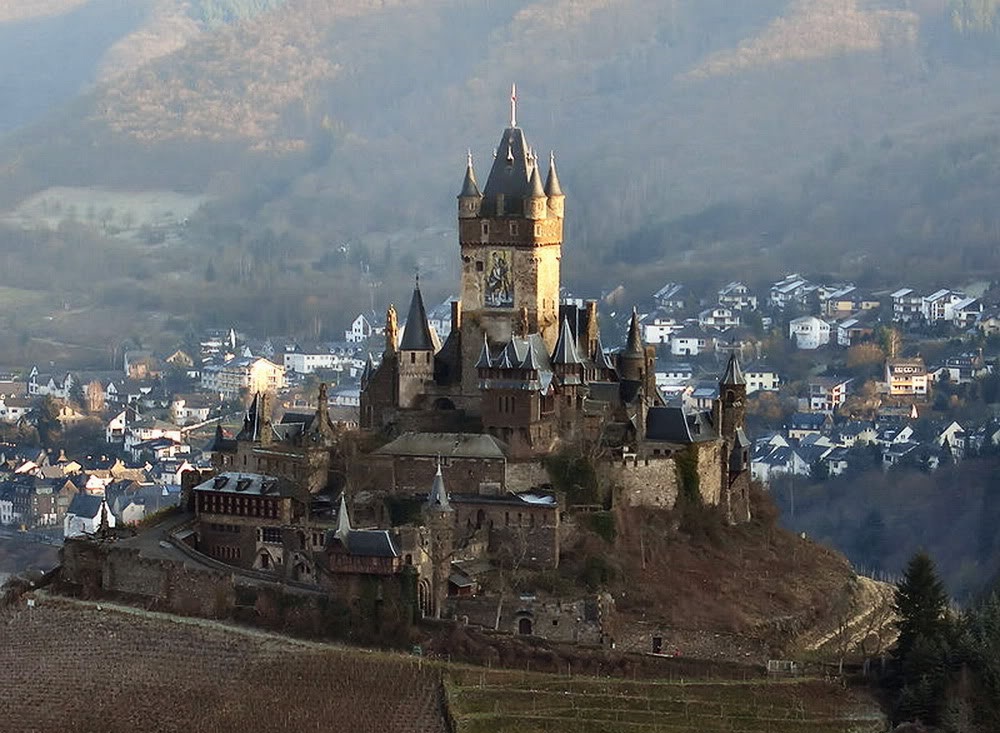
Overlooking the Mosel River and located about halfway between Frankfurt and Aachen, the original 11th century castle was burned down by invading French troops in 1689. However, it was rebuilt in the neo-Gothic style by Berlin businessman Louis Ravene in 1868, under the direction of Julius Carl Raschdorff, architect of the Berlin Cathedral. The castle was used as the Ravene family's summer residence for almost 100 years.


Salviati decorated the castle's tower with a 300 square foot mural of St. Christopher, who is carrying the Christ child on his shoulder.


Today, the town of Cochem owns the castle and it is a popular tourist attraction.

Update: Per Cochem Castle, the tower and the original mosaic were destroyed in World War II. A reproduction of the Salviati mosaic was installed in the 1960s.

Sources:
Barr, Sheldon. Venetian Glass Mosaics: 1860-1917. London: Antique Collectors' Club, 2008. 127.
History of Cochem Castle
The Reconstruction of Cochem Castle
Holger Weinandt on Wikimedia Commons
Emily Smith Pearce