Showing posts with label WWII. Show all posts

Wednesday, January 29, 2014

St. George Church, Clyst St. George

The ancient church was rebuilt in 1854-55, but it was gutted by air raid fire in 1940. It was rebuilt again in 1952.


Sometime between September 1862 and October 1863, Salviati decorated the church's western wall with mosaics of angels with widespread wings supporting scrolls of Scripture on the request of the same Reverend Ellacombe who supervised the 1850s restorations. Unfortunately, the mosaics did not seem to have survived the World War II damage.

Sources:
Salviati, Antonio. On Mosaics (generally). Leeds, 1865. 46.
Wikipedia
Cherry, Bridget and Nikolaus Pevsner. Devon. New Haven: Yale University Press, 1991.  271.
Ellacombe, Henry Thomas. The History and Antiquities of the Parish of Clyst St. George Exeter Diocesan Architectural Society, September 22, 1862. 70.
Robin Drayton on Geograph
Robert Slack's flickr Photostream

Wednesday, September 18, 2013

Cafe National, Berlin

By 1886, Dr. Salviati had a shop in Berlin at Friedrich Strasse 149 (in the Central Hotel), while the Venice and Murano Company had theirs in Linden Strasse 16. Salviati mosaics decorated many buildings in the area, including the Cafe National, built by A. Vogt located on the corner of Friedrich and Jager Strasse.


The interior of the cafe contained four mosaic pictures designed by Wiener representing four different nations. The building no longer exists.


Sources:
Barr, Sheldon. Venetian Glass Mosaics: 1860-1917. London: Antique Collectors' Club, 2008. 136.
Baedeker, K. Northern Germany: Handbook for Travellers. Ninth edition. Dulau and Co., London, 1886.
eBay

Thursday, August 29, 2013

Ethnological Museum, Berlin

Located next to the Museum of Decorative Arts (also known as the Gropius Bau) at Koniggratzer Strasse 120 (now Stresemann Strasse), this museum was built in 1880-86 by architect Hermann Ende.


Otto Lessing designed cartoons of the (then) seven planets and the solar system, seasons, arts and industry, as well as phases of life which Salviati applied in mosaic to the ceiling of the circular entrance hall.


As with many of Berlin's buildings, this museum was also damaged in World War II. It served as the Museum of Pre- and Early History until 1961, when it was eventually razed.


In 1954


In 1961

The southeastern corner of Stresemann Strasse and Niederkirchner Strasse now contains a parking lot.


Sources:
Barr, Sheldon. Venetian Glass Mosaics: 1860-1917. London: Antique Collectors' Club, 2008. 136.
Grieben-Verlag. Berlin, Potsdam und Umgebungen: Praktischer Wegweiser. 118.
Westermann, George et. al. Westermanns Monatschefte. 62. G. Westermann, 1887. 375.
Academic
Staadliche Museen zu Berlin
Wolfsraum's flickriver
Architekten-Verein zu Berlin. Berlin und Seine Bauten: Der Hochbau. Berlin: W. Ernst, 1896. 228-229.
Potsdamer Platz 
Google Maps
eBay

Friday, August 23, 2013

New York Insurance Company, Berlin

Not to be confused with the New York Equitable Insurance Company at 43 Leipziger Strasse, this building was designed in 1880 by Kayser and von Grossheim and was located farther west, on the corner of Leipziger and Wilhelm Strasse.


Two facades of the palace contained Salviati mosaics of allegorical depictions of cities modeled after cartoons by Otto Lessing. They included: London, Paris, Berlin, Vienna, New York, and Rome.


Facade detail of the mosaics featuring two cities between windows on the third and fourth levels

Although the building next to it at 125 Leipziger Strasse survived, the New York Insurance Company building was destroyed in World War II. In typical Berlin fashion, it's been replaced by a modern office building.


Sources:
Barr, Sheldon. Venetian Glass Mosaics: 1860-1917. London: Antique Collectors' Club, 2008. 136.
Grieben-Verlag. Berlin, Potsdam und Umgebungen: Praktischer Wegweiser. 140.
Guide through Germany, Austria-Hungary, Italy, Switzerland, France, Belgium, Holland and England. Berlin: J. Reichmann and Cantor, 1896. 12.
Baedeker, Karl. Northern Germany: as far as the Bavarian and Austrian frontiers. 10th ed. London: Dulau and Co., 1890. 55.
Europeana
Senatsvervaltung
Kleinanzeigen eBay
Zeno

Wednesday, August 14, 2013

Halle Opera House

When this theater was built in 1886, it was known locally as the Stadt-Theater Halle. It was designed by Heinrich Christian Seeling.


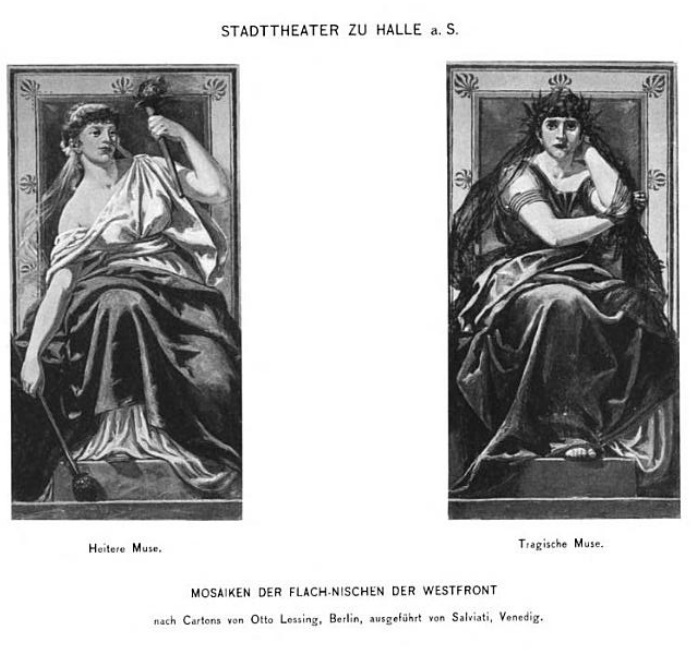
Salviati's mosaic figures and ornaments, designed by Otto Lessing of Berlin, decorated the original building's western facade including the spandrels above the arched windows, as well as the niches above the staircase.


The muses of Serenity and Tragedy were depicted in the mosaics located in the flat niches.


A bomb attack on March 31, 1945 destroyed much of the theater and it was subsequently rebuilt between 1949 and 1954.


Sources:
Barr, Sheldon. Venetian Glass Mosaics: 1860-1917. London: Antique Collectors' Club, 2008. 130, 136.
Staude, Gustav. Das Stadt-theater zu Halle. 1886. 15, 59. 
Wikipedia
Wikimedia Commons
Musical-total
Theatre Database

Friday, August 2, 2013

Central Hotel, Berlin

Located on Friedrichstrasse between Georgenstrasse to the north and Dorotheenstrasse to the south, and facing the Central Railway Station, this grand hotel was built in 1878-80. It was designed by architects Hermann Von der Hude and Julius Hennicke.  It boasted having a telephone, electricity, three elevators, and baths on every floor.


Georgenstrasse corner with one of the building's four 98 foot high coupolas

A mosaic frieze designed by Herman Geber ran above the eighty-eight second floor windows/window-doors on the external facade. It was composed of flower garlands adorning the names of the world's most important cities on a gold background. The central panel on the Georgenstrasse corner clearly shows "Constantinopel" (sic).


The Dorotheenstrasse corner


In 1881, Salviati had a showroom in the Central Hotel, while the Venice and Murano Company had theirs nearby at 16 Lindenstrasse. Containing 600 rooms, in 1885 the Central Hotel was still the largest hotel in Germany.


The covered courtyard, or Winter Garden, held 2,500 people and it hosted one of Berlin's best-known variety theaters starting in 1887. The entire hotel was destroyed in World War II.


Dorotheenstrasse corner, March 21, 1945


The same corner today

Sources:
Barr, Sheldon. Venetian Glass Mosaics: 1860-1917. London: Antique Collectors' Club, 2008. 135.
The Builder. April 24, 1880. 504.
Baedekker's Guide Books: Northern Germany. 1881.
Wikimedia Commons Scan from book: Landesdenkmalamt Berlin (Ed.), Denkmale in Berlin, Bezirk Mitte, Ortsteil Mitte, Petersberg 2003, p. 112.
Wikimedia Commons W. Pembroke Fetridge Harper's hand-book for travellers in Europe and the east, 1, Harper & Brothers
Dr. Habbo Knoch, Habilitationsprojekt, postcard from 1898
Wikimedia Commons postcard from 1900
Wikimedia Commons destruction, March 21 1945

Monday, July 29, 2013

St. Jude's Church, Whitechapel

Reverend Samuel Augustus Barnett and his wife Henrietta specifically asked London's Bishop to take over the empty and neglected St. Jude's Church (build in 1848) in the city's run-down and crime-ridden Whitechapel neighborhood in 1873. Whitechapel became infamous in 1888 when it served as the location of Jack the Ripper's murderous rampage.


The Barnetts were instrumental in their efforts of cleaning up Whitechapel and in 1885, three years after they began their annual art exhibits, they received from their friends a mosaic copy of G.F. Watts' 1866 "Time, Death, and Judgment". The cartoon for the mosaic was by Cecil Schott and it was executed by Salviati.


Schott's 1884 cartoon


Finished mosaic

Watts himself was critical of the potential result because he could not supervise the work's execution. However, it received praises from the International Correspondence Schools, which wrote that "the mosaic has very faithfully reproduced the picture itself . . .." Matthew Arnold revealed the gift to the Barnetts in Toynbee Hall and the mosaic was later placed on the western exterior wall of the church above a fountain.


In 1923, St. Jude's parish was merged with St. Mary's Matfelon. Like many other buildings in the area, both were destroyed in the blitz of World War II.  The adjacent Toynbee Hall (1884) and the nearby Whitechapel Gallery (1901), both also founded by the Barnetts, still exist.

Although he wasn't considered a suspect at the time, Reverend Barnett's name has come up in more recent speculation regarding the identity of Jack the Ripper. However, given the church's location, the infamous murderer - whoever he may have been - more than likely strolled by the mosaic and perhaps even stopped to ponder the meaning of "Time, Death, and Judgment."

Update: The mosaic can now be found in St. Giles-in-the Fields church in London's west end, where it hangs in the staircase of the south lobby.


Sources:
Arnold, Matthew. Essays, Letters and Reviews. Cambridge: Harvard University Press, 1960.  255.
Barnett, Henrietta. Canon Barnett, warden of the first university settlement, Toynbee Hall. 74.
Barnett, Henrietta. Canon Barnett: his life, work and friends. 170.
AIM25
National Gallery of Canada. For the collection of European and American art. 2010. 3.
The Critic. London: Good Literature Publishing Co. 4. 1885. 310.
International Library of Technology. Tile and parquetry designing. Scranton: International Textbook Company, 1916. 21.
Casebook 
St. Giles Online
Andrew Liu for St. Giles Online

Tuesday, July 23, 2013

Kayserzinn Headquarters, Cologne

Located on the corner of 85-87 Hohe Strasse and Bruckenstrasse, this magnificent building contained the Cologne headquarters of metalworkers J.P. Kayser & Sohn. Built 1884-86, it was actually designed by Heinrich Joseph Kayser (of Kayser and Grossheim), the younger brother of tinsmith Engelbert Kayser.


Salviati decorated the facade with mosaics of four periods, infants, and ornaments after cartoons by Otto Lessing.


Much of Cologne was destroyed in World War II, including the Kayser building which was hit in 1943, but the area has since been rebuilt. Containing many shops and leading to Cologne Cathedral, it is now a popular pedestrian area.


Sources:
Baldry, Alfred Lys. Modern Mural Decoration. London: George Newnes, Ltd., 1902. 52.
Barr, Sheldon. Venetian Glass Mosaics: 1860-1917. London: Antique Collector's Club, 2008. 136.
Bilderbuch Koeln
Wikipedia DE
Wikimedia Commons
Wikipedia

Wednesday, July 10, 2013

Pringsheim Palace, Berlin

Wilhelmstrasse 67 was designed by Gustav Ebe and Julius Benda in 1873 for railway owner Rudolf Pringsheim.


Anton von Werner designed the Lebensalter ("old life") mosaic frieze on the facade that was executed by Salviati.


The house was extensively damaged during World War II and it was demolished in 1950. While the mosaics are most likely lost, von Werner's original oil paintings for the design have survived and at least one of them can be found in the Galerie Neuse in Bremen.


Juventus


Amicita


Amor

Felicitas


Ars


Exitium

Sources:
Baedeker, K. Northern Germany: Handbook for Travellers. Ninth edition. Dulau and Co., London, 1886.
Barr, Sheldon. Venetian Glass Mosaics: 1860-1917. London: Antique Collectors' Club, 2008.

Tuesday, June 11, 2013

Malbork Castle

Also know as Marienburg, this castle was built by the Teutonic Knights in the late 13th century.  It also served at times as part of the Prussian royal residences.


More than half of the castle was destroyed during World War II.


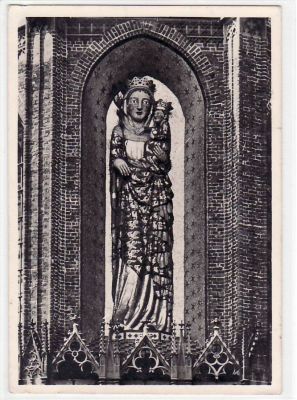
The exterior of the east window of the upper chapel was decorated by the first examples of exterior mosaics by Salviati in what was then still part of Germany. This was restoration work done in 1869-70 to previous mosaics (also Venetian, from the 14th century) adorning the niche of the giant (8 meters) statue of the Virgin Mary. Unfortunately, these mosaics also did not survive the wartime bombings.


A pre-World War II postcard showing the statue and mosaics still intact on the chapel.


The mosaics formed a background of gold with blue stars.


Malbork Chapel with the empty space that previously featured the mosaics and the Virgin


In 2008, an advertisement for a local religious organization showed what the chapel used to look like.

Sources:
The Architect and Contracted Reporter: A Weekly Illustrated Journal of Art, Civil Engineering and Building. "Mosaics in Germany." Vol. 5, April 8, 1871. 182.
Castles and Palaces of the World
Wikipedia
Malbork
pBase gallery
forum Marienburg.pl
Akpool.de
Stadtapartment
Mysteries and Curiosities of Malbork Castle

Wednesday, May 15, 2013

Reichsburg Castle

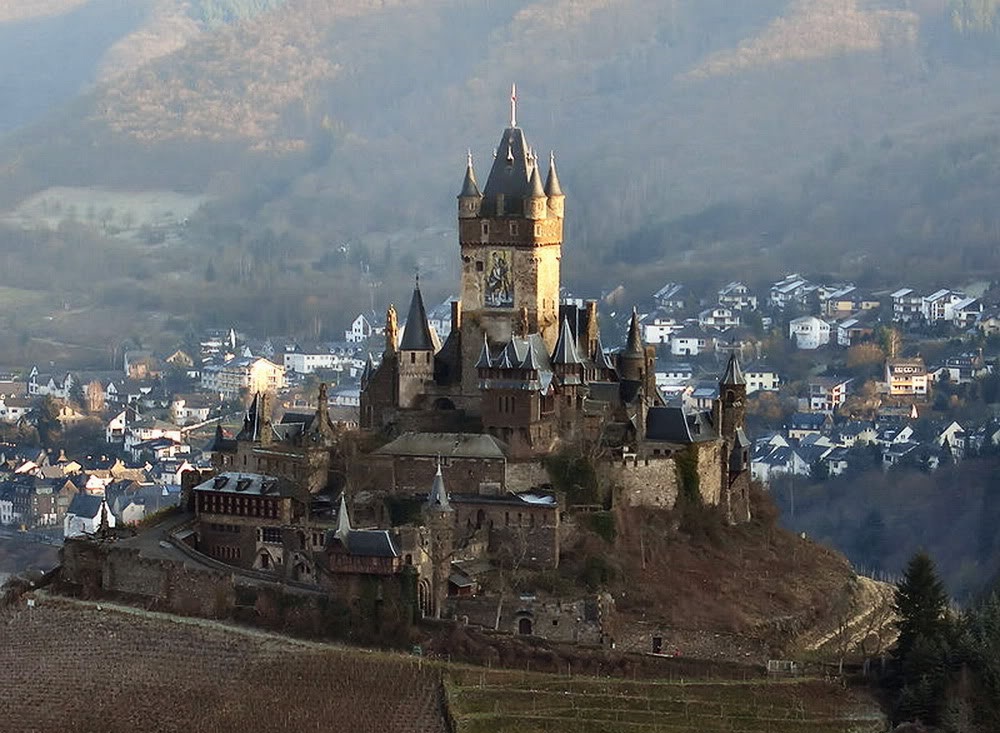
Overlooking the Mosel River and located about halfway between Frankfurt and Aachen, the original 11th century castle was burned down by invading French troops in 1689. However, it was rebuilt in the neo-Gothic style by Berlin businessman Louis Ravene in 1868, under the direction of Julius Carl Raschdorff, architect of the Berlin Cathedral. The castle was used as the Ravene family's summer residence for almost 100 years.


Salviati decorated the castle's tower with a 300 square foot mural of St. Christopher, who is carrying the Christ child on his shoulder.


Today, the town of Cochem owns the castle and it is a popular tourist attraction.

Update: Per Cochem Castle, the tower and the original mosaic were destroyed in World War II. A reproduction of the Salviati mosaic was installed in the 1960s.

Sources:
Barr, Sheldon. Venetian Glass Mosaics: 1860-1917. London: Antique Collectors' Club, 2008. 127.
History of Cochem Castle
The Reconstruction of Cochem Castle
Holger Weinandt on Wikimedia Commons
Emily Smith Pearce