Showing posts with label Monument. Show all posts

Wednesday, February 26, 2014

Funerary Monuments in Croatian Cemeteries

Ivan Rendic was a Croatian sculptor who studied in Italy - including in Venice - and later worked extensively out of Trieste. He made numerous funerary monuments in the cemeteries around Rijeka (including Kozala, Trsat-Susak, Opatija and Bakar), some of which Salviati also decorated with enamel mosaics. A catalog prepared for the 1893 World Columbian Exposition does not detail exactly which memorials Salviati worked on (and erroneously lists Trieste as the location of the cemeteries), but the following examples were all made by Rendic before 1893 and are embellished with mosaics.


The interior of the Gorup family mausoleum from 1882 in Rijeka's Kozala cemetery. Josip Gorup had the memorial built after the death of his wife in childbirth, and the carved relief shows the separation of a mother from her eight children.


The Devet/Spilar-Ambrozic memorial from 1885 in the Kozala cemetery.


The Pilepic monument from 1890.


The Stiglich family tombstone from 1891.

The Bakarcic monument from 1892 in the Kozala cemetery.

Sources:
Barr, Sheldon. Venetian Glass Mosaics: 1860-1917. London: Antique Collectors' Club, 2005. 126.
Metzger-Sober, Branko. "Funerary Monuments by Ivan Rendic in the Croatian Littoral." Ars Adriatica. 3. Dec 2013.
Wikipedia

Monday, October 28, 2013

Tyndale Monument

This 111 foot (34 m) tall tower was built in 1866 by architect S.S. Teulon in honor of William Tyndale, translator of the New Testament.


Salviati decorated the cross on top of the monument with gold enamel Venetian mosaics.


Sources:
Salviati, Antonio. On Mosaics (generally). 1865. 50.
Wikipedia
Illustrated London News. November 17, 1866.
W. Lloyd MacKenzie, via Flickr @ http://www.flickr.com/photos/saffron_blaze/

Friday, February 22, 2013

Berlin Victory Column

The Victory Column or Siegessaule was designed by Heinrich Strack and inaugurated in 1873.


The columned rotunda around the base contains a 800 square foot frieze of Salviati mosaics from 1874-75 designed by Anton von Werner.


The mosaics commemorate the events of Janaury 18, 1871 when King Wilhelm I of Prussia was made Emperor of a united Germany in the Hall of Mirrors at Versailles.


Germania - representing the Holy Roman Empire - confronting Napoleon


 A handshake representing the symbolic union of north and south German states.


Otto von Bismarck reading the proclamation of the German Empire.


Detail of a trumpeter


Germania sitting on the throne of the Empire, accepting the crown on Kaiser Wilhelm's behalf.

Sources:
olilau83's flickr Photostream
Thomas Wolf on Wikimedia Commons
Wikipedia
will.pimblett's flickr Photostream
medebb3's flickr Photostream
Barr, Sheldon. Venetian Glass Mosaics: 1860-1917. London: Antique Collector's Club, 2008. 50.

Thursday, February 7, 2013

Chamberlain Memorial of Birmingham

Located across the square from the Birmingham Council House, this monument was erected in 1880 to honor local M.P. and businessman Joseph Chamberlain.


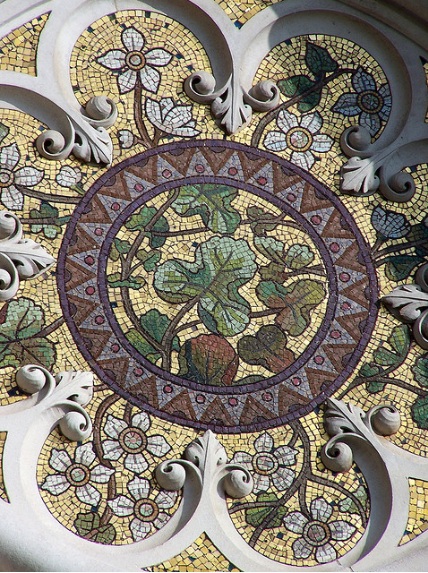
Designed by John Henry Chamberlain, the structure bears a strong resemblance to G.G. Scott's Albert Memorial in London's Hyde Park. The mosaic embellishments consisting a floral motif were made by Salviati, Burke and Co.


The general stonework was by J. Barnsley and Sons and the carving was by S. Barfield and assistants.

Sources:
Wikipedia
GVG Imaging's flickr Photostream
Jan Grant's flickr Photostream
The urban snapper's flickr Photostream
The Building News and Engineering Journal. Vol. 39. Sept. 10, 1880. 315.

Friday, January 25, 2013

Funerary Monument of Giulio Salviati

Brookwood Cemetery in Surrey, England contains the grave of Antonio Salviati's son Giulio Salviati who was born in Naples in 1843 and died on March 4, 1898. Misidentified as Luigi Salviati by the New York Times, the master glass maker - whose father's accomplishments were mistakenly attributed to him by the paper - had committed suicide at the age of 55.


The four sided, obelisk-like base contains the Salviati company's trademark enamel mosaics. It was erected to Giulio by his widow Henriette.


Sources:
New York Times
Murano Magic
tanyajane100's flickr Photostream
mira66's flickr Photostream