Showing posts with label Clayton. Show all posts

Wednesday, August 28, 2013

Albert Memorial

G.G. Scott won the competition to design this memorial to Queen Victoria's late husband in 1863. It is located in London's Kensington Gardens, just to the north of the Royal Albert Hall and not far from the Princess Diana Memorial Fountain.


The cartoons for the eight exterior spandrels, four triangular gables, and the interior of the dome were painted by J.R. Clayton, which Salviati decorated with 1,200 sq ft of Venetian mosaic.


South facade - Poetry


East facade - Painting


North facade - Architecture


West facade - Sculpture

Albert was a great patron of the arts and the gables depict enthroned allegorical figures of Painting, Sculpture, Poetry, and Architecture, while the spandrels shows the artists at work in those fields.

Sources:
Barr, Sheldon. Venetian Glass Mosaics: 1860-1917. London: Antique Collectors' Club, 2008. 18-20.
Wikimedia Commons Photo by DAVID ILIFF. License: CC-BY-SA 3.0
Monceau's flickr Photostream
Photosecrets
Losing It

Thursday, June 20, 2013

Royal Military Chapel, Wellington Barracks

The chapel was built in 1838 and it has served the seven Regiments of the Household Division. It is the only remaining military chapel in London.


G.E. Street remodeled the chapel in 1877-78.


1882 interior drawing


1899 photograph


The chapel was heavily damaged by bombing during World War II, first during the blitz in 1940 and 1941, and then more seriously in 1944 when 121 soldiers and civilians were killed.


It was rebuilt in the early 1960s and the chancel mosaic can still be seen in the original chancel, which had remained intact.


The chancel is decorated with three scenes: the Bearing of the Cross, the Crucifixion and the Descent from the Cross. John Clayton designed the cartoons for the mosaics, which were executed by Salviati and Burke.


Sources:
London Wellington Barracks. Royal Military Chapel, Wellington Barracks. London: Hatchards, Piccadilly, 1882. 76.
"The Royal Military Chapel Wellington Barracks." The Architect. May 29, 1879. 331.
John Salmon on Wikimedia Commons
Wikipedia
British Army
British Listed Buildings
Colin Hepburn's flickr Photostream
English Heritage
War 44 Forums
Paul Farmer on Geograph
The Guards Chapel Tragedy
eBay
Prints-4-All

Monday, April 29, 2013

Westminster Abbey

Arguably one of the most recognizable buildings in England, the Collegiate Church of St. Peter at Westminster was founded in the 10th century, possibly earlier. In 1245, Henry III started the construction of the present church.


G.G. Scott designed the altar and reredos that were erected in 1867. The mosaic of The Last Supper is by Salviati based on a cartoon by John R. Clayton, while the sculptures are by Henry Hugh Armstead.
 

An article in The Illustrated London News from 1867.


 The reredos circa 1870-90.


The Salviati reredos today.


Prince William and Kate Middleton got married in front of this altar in April 2011.


Sources:
Wright, John. Some notable altars in the Church of England and the American Episcopal Church. New York: The MacMillan Company, 1908. 74.
The Jane Austen Film Club
English Heritage's flickr Photostream
The Anglophile
Knox News
eBay UK
Time.com
Papers Read at the Royal Institute of British Architects. Session 1868-69. London: Rooms of the Institute. 1869. 45.

Tuesday, April 23, 2013

Holy Trinity Brompton

Much of the interior of this 1829 London church was redesigned by Arthur Blomfield in 1879-82.


The sanctuary reredos from 1885 was designed by John R. Clayton.


The central figure of Christ Enthroned surrounded by angels is flanked on either side by a total of twelve individual figures, including John the Baptist, St. Peter, King David and the Virgin Mary.


Sources:
British History Online: Survey of London 41, Page 32
British History Online: Survey of London 41, Pages 33-49
Barr, Sheldon. Venetian Glass Mosaics: 1860-1917. London: Antique Collectors' Club, 2008. 125.
Castor, David. Wikimedia Commons
Marcus Perkins Photography
London 365 Photo
Alaistair Humphreys' flickr Photostream
American Institute of Architects. Architectural  Record. Vol 2. New York: The Record and Guide, 1893. 81. 

Tuesday, March 26, 2013

Albert Memorial Chapel, Windsor Castle

Among Antonio Salviati's first English commissions was an 1862 request from Queen Victoria for the decoration of the Wolsey Chapel in the east passage of St. George's Chapel at Windsor Castle, which was turned into the Albert Memorial Chapel soon after the December 1861 death of her beloved husband.


In addition to the tomb of Victoria's grandson Albert, Duke of Clarence (d. 1892), the chapel also contains the remains of her youngest son, Prince Leopold (d. 1884).

View of the eastern-end windows.


The 28 panels of the west wall's blank window are decorated with mosaics of full-length figures of historic individuals who have some type of connection to Windsor Castle including British Kings, Queens and Prelates. This section of mosaic was ordered separately in 1864.


The extensive ceiling mosaics that cover about 2,100 square feet, as well as the soffits of the side windows feature 92 angels, heraldry and floral motifs. The general designs were by G.G. Scott and the cartoons were created by J.R. Clayton. The ceiling mosaics were completed first, and the pre-fabrication (in Venice), transportation to London and installation took a total of ten months.

Sources:
London Connection
Barr, Sheldon. Venetian Glass Mosaics: 1860-1917. London: Antique Collectors' Club, 2008. 18.
College of St. George Chapel Archives
Le Monde1's flickr Photostream
Aaron K Hall's flickr Photostream
Striderv's flickr Photostream
Mary Scots' flickr Photostream
Papers Read at the Royal Institute of British Architects. Session 1868-69. London: Rooms of the Institute. 1869. 44.

Tuesday, January 29, 2013

St. Erasmus Chapel in Chester Cathedral

The high altar of Chester Cathedral contains a mosaic of the Last Supper by Salviati from 1876. Around 1870 during the restoration by G.G. Scott, the south aisle of the cathedral was shortened and its east end was converted into the St. Erasmus Chapel.


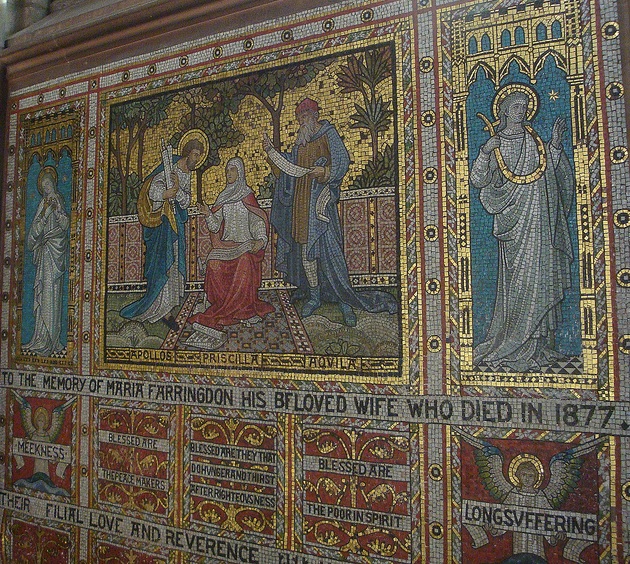
Designed by Clayton and Bell, the Salviati mosaics in the chapel from 1879 are dedicated to the memory of railroad contractor Thomas Brassey (1805-70) and his wife Maria Farringdon Harrison (d. 1877) by their sons Thomas, Henry Arthur (Harry) and Albert Brassey. Thomas the younger had built the Brassey Institute in Hastings.


Sources:
Wikipedia
Budby's flickr Photostream
Colin Sabin's flickr Photostream

Friday, January 18, 2013

St. Agnes' Church Newmarket

Consecrated in 1887, this small, Victorian church was designed by Richard Herbert Carpenter in the Decorated style and built in the memory of W.S. Stirling Crawfurd, Esquire by his wife, Caroline Agnes, the Duchess of Montrose.


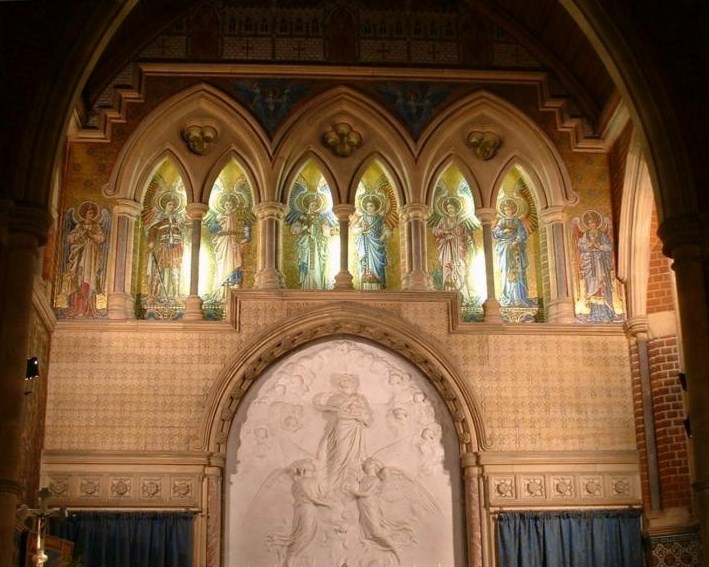
The interior barely seats 100 people,  but the decorations above the altar - including the triple-arcaded Salviati mosaics - may be the most elaborate in all of Suffolk. The chancel on the east end contains a marble reredos, above which are the mosaics that represent the "Angelic Order" and "Heavenly Jerusalem", which were designed by John R. Clayton.


Sources:
St. Mary's and St. Agnes' Church
Suffolkchurches
James Yardley Geograph pictures
Newmarket's Personalities from the Past - VI
Pearson, Lynn. "Suffolk" in PDF format.
Barker, H.R. West Suffolk. Bury St. Edmund's: F.G. Pawsey and Co. Ltd., 1907. 278.
English Heritage
American Institute of Architects. Architectural  Record. Vol 2. New York: The Record and Guide, 1893. 81.

Friday, December 28, 2012

Chester Cathedral

Also known as Cathedral Church of Christ and the Blessed Virgin Mary, the current building dates back to the 13th century.


The building underwent a major restoration in 1868-76 by G.G. Scott, leading to its current high Victorian look.


A Salviati mosaic of The Last Supper from 1876 designed by J.R. Clayton decorates the high altar.


Salviati mosaics can also be found in the St. Erasmus Chapel of the cathedral.

Sources:
British Listed Buildings
Chester Cathedral
Colin Sabin's flickr Photostream
“The New Mosaic Reredos in Chester Cathedral.” The Art Journal (1875-1887) 2 (1876): 351.

Thursday, December 20, 2012

St. Curig's Church

Opened in 1883, this church in Wales by architect G.M. Roberts has now been converted to a Bed and Breakfast, but its original Salviati mosaics have been preserved.


The composition depicting Christ surrounded by angels that is located in the former apse can still be seen in the space now used as a dining room and guest area.


The mosaic is thought to have been commissioned by William Edward Sackville-West, the estate manager to Lord Penrhyn, in memory of the former's wife and was based on cartoons by Clayton and Bell.


Sources:
Bed and Breakfast Capel Curig
Capel Curig Tourist Information
Barr, Sheldon. Venetian Glass Mosaics: 1860-1917. London: Antique Collectors' Club, 2008. 125.